I have been a bit busy for the past few months with the process of preparing for bargaining, which has affected my ability to communicate here. We have been in countless meetings together, both in person and online and on the phone. Additionally, we are now in the actual process of bargaining for the past month, beginning July 8th and 9th in Berkeley. However, I thought I would discuss a particular incident from bargaining since it is relevant to some of the conversations on the blog over the past couple of years. Typically, the first topic of conversation in bargaining is the question of ground rules, or the rules that each side accepts when they go to the bargaining table. The union and management will fight over topics ranging from times of bargaining to media access and other issues. My counterpart from Irvine, Jessica Conte, wanted to make the issue of police presence an issue at bargaining, calling for an agreement that neither side would bring in the police.
We wanted this agreement because of an incident that occurred earlier this year around health care caps. A few months ago, the union had kicked off a fairly substantial campaign to get the caps on health care removed, and to get the university to live up to the fairly minimal standards of the Health Care reform act. We got a lot of folks out to make this issue a concern, and formed useful alliances with other student organizations in the process. Within that context, the university agreed to meet officially with the union on the topic in Irvine. In response, we organized a number of rank and file folks to be in the room so they could hear about what was going on, and to let the administration know that this was an important issue to our membership. In response, we got about thirty folks out to make the meeting. In response, the university brought out a pair of police officers who followed us into the negotiation room and began to take photographs. In response, our head steward, Jamie Rogers, asked that our conversation occur without the presence of the police. The police officer stated that he did not work for her. However, when labor relations official Nadine Fischel went over to ask them to leave, they did so, quickly.
It's hard to argue that this difference of responses doesn't indicate a radically different power relation in regards to the police. If the police don't explicitly work for the workers and students of the university, they seem to implicitly work for the administration of the university, for the management and the bosses. In effect, the university has a group of primarily men with guns, who they can put between themselves and the people who they ostensibly work with. Within our conversation, we tried to make this a central point for arguing for this provision of the ground rules. In response, the labor relations folks tried to draw a stark line between bargaining and protests, implying that events such as the one that caused us to call for the rule functionally didn't happen (as if having a labor relations person establishing an implicit role of supervision to the cops was helpful). In response, I noted that the administration called the cops in many cases when students and workers simply went to petition the administration. Fischel's response was to refer to this sort of behavior as 'storming the chancellor's office. Fischel went on to argue that the only legitimate way to enter in to the office was with an appointment.
Within this context, it makes sense that university officials would call the police on small groups of students trying to deliver petitions, parents with children attempting to meet with housing administration to discuss dangers from construction on their housing, and, in one case, a student simply knocking on the door of the office of public information to find out about a public informational request. It also goes along with the harassment of activists for legal activities by university administration and police. However, it doesn't make a lot of sense if you accept the principle that the university is a public institution that is responsible to those individuals. It's within this context that we need to understand the position taken by labor relations, a minion and lackey of the regents who have made it their mission to privatize the university. The discomfort they claim is the discomfort of a class of individuals who refuse to recognize that they are a part of a public and democratic institution, which is probably due to the fact that the majority of them are used to the dictatorial powers they held and hold in their corporate positions. It's approach to the daily life of the university that is created by the regents and the university of california office of the president (UCOP) and is filtered down through the ranks of the UC administration. Within this context, this discomfort seems to indicate that the UCI administration is simply not competent to fulfill the basic roles of their employment, an issue likely not unique to them. It's a sign that we need to get rid of them.
Showing posts with label UCI. Show all posts
Showing posts with label UCI. Show all posts
Thursday, July 11, 2013

Monday, June 18, 2012
On the recent housing fights in Verano
The local branch of our union has been involved in the fight to defend affordable housing for graduate students for the past quarter. For those who aren't aware of the situation, the cost of housing is far out of the range of our wages as graduate students. In fact, housing costs are so high that the university not only has to provide subsidized housing for students, but for faculty, staff, and administrators. Over the past few years, the university has expanded that housing, but that expanded housing is largely privatized and often costs as much as our entire salary. Affordable housing is typically considered to be 30%, and only a small percentage of the university's housing fits that category, all of that within Verano Housing. However, that housing is increasingly disappearing. The university has been increasing the price of the cheapest housing after minimal upgrades, and its beginning to demolish some of the cheapest housing despite no plans to build alternative housing. In effect, housing prices are going up. These decisions have translated into a lot of anger amongst graduate students, who have gotten involved in our fight to end the demolitions and to make our housing genuinely affordable.
Most of the work involved in the campaign has been very traditional organizing. Organizers and rank and file activists have been going door to door in the Verano units, talking to folks in the affected units. We have been making phone calls, passing out petitions, and holding meetings to discuss the problem. It's been remarkable to see the transition of our local unit moving from an existence as a rotten borough into a real social force on our campus. A lot of credit needs to go to our paid organizers, Alfredo Carlos and Tetsuro Namba, but they've hardly been alone in the fight. We've seen impressive work from the majority of our elected leadership, along with a lot of rank and file folks. If I were to be honest in representing the folks involved, this posting would look more like a phone book. The rank and file has been energized through this work, and our meetings have been well attended and energetic. The Verano administration has not responded well to this campaign, harassing organizers, setting up meetings stacked with administrators to intimidate residents, and selectively enforcing regulations for leaving information on people's doors.
The most recent incident in the administration backlash against this movement came in the form of an attack on families in the area. Verano housing not only has the cheapest student housing, but it has the vast majority of family housing. Within that context, the various porches of the ground level housing are frequently littered with the various toys, cooking equipment, and jungle gyms of those families. The truth is that this level of mild disorder contributes to the quality of living in Verano, and makes the space feel like a place where people live, rather than sterility that defines the majority of the planned community of Irvine. Up until the present, the administration has let this chaos of life pass, but for reasons only explicable to the current folks running Verano, this has changed. One family was told by the administration through written communication that they had to move their swing set or the administration would demolish it. This set up had been in place for at least two years without comment from the housing administration. We we brought in to support the family by Bron Tamulis, a longtime activist and friend of the family. With that, we decided to play the role of an ally in this struggle. Before I move on to the events of the day, I want to emphasize the fact the administration made no effort to have a conversation with the family, to treat them with the respect that they deserve.
A group of us met at the house of the family in order to support them in a non-confrontational manner. The family decided to move their playground equipment off the grass onto the cement porch in order to cooperate with the admin. It's important to note that the common space that they were using was not accessible to residents and was largely unusable, but the family wanted to make a good faith gesture to their landlords. Unfortunately, this gesture was not reciprocated by the administration. Instead of appearing to have a direct conversation with the family, they only appeared when we left for the Verano office in order to find out what was going on. When we reached the office, we were met with a lot of defensiveness on the part of the staff. They wanted us to move out of the waiting room into the common area in order to take us out of the public eye. We were not told when the director would come back and when we sent a small delegation to find out more details the administrators threatened to call the police on us, which they later did. When the director of Verano, Beverly Chaney, did eventually show up, she was immediately hostile, refused to talk while students were taping her remarks, and fled from the room almost immediately. When we attempted to return to the waiting area to read our statement. At that point a group of three police officers appeared, and we read the letter to a silent staff, and went outside to have a conversation with the police.
It's important to note that our group remained calm throughout this process. We consisted of graduate students and a number of children, requesting answers from the staff. Some folks brought cameras precisely because of the nonsense that started the situation itself, the refusal to directly engage with the family, and to indirectly send orders that contradicted the informal practices of the space. Rather than dealing with this situation, Chaney brought in three men with guns to act as a barricade between herself and the residents she ostensibly works for. I want to linger on the point for a while, because it represents the dominant response of the administration. Whenever students or workers petition their grievances with the university, we are met with a phalanx of men with guns, irrespective of actual behavior. We are always a potential threat, and are undeserving of the respect that comes from any sort of actual engagement, because that phalanx was inevitably brought in to allow the administrators to escape out the back door. When on the few occasions that we do see these individuals for limited amounts of time, they lie, prevaricate, and dissemble. In my eight years of being on camps, I've come to the point when I hear from a representative of the university that their inevitably punitive decision has a long precedent, I know that the decision is probably without precedent. We need to see this combination of deception, force, and lack of engagement precisely as a de facto system of collective and disempowerment, and an effect of the privatization of the university.
I want to make a point before I continue on. We as graduate students are far from the most poorly treated group on campus. After all, we haven't had to face the sorts of threats posed to the groundskeepers and janitors as they went through their years long campaigns to become insourced university workers, but despite that relative privilege, we are treated like shit by this university. As a final point, there was a curious interaction between us and the police officers at the end of our event. One of the administrators came out to imply that we were intimidating them by attempting to enter their offices. Our criminal behavior evidently consisted of attempting to use the same hallway to get to the waiting area that the staff had initially sent us through. Upon hearing this, the officer told us that we should respect the privacy of the admin, and asked us if we would like it if they (the admin, I presume) came into our kitchen. It's difficult to see how a workplace for a public university is the equivalent to the space of a private house, but perhaps more significantly, these folks send people into our kitchens, bathrooms, and bedrooms all the time. Our houses are constantly under inspection, often without meaningful warning, and early in the morning. The same individuals who feel free to enter into every aspect of our lives to the point of threatening to demolish children's play things, react with indignation when their public workplace is treated in that manner. If there is an argument for the category of privilege, it might be found in this hypocritical contradiction.
Our fight for a public education is tied into the fee hikes of privatization, but we need to recognize that those fights are the same fights as the fights for our ability to have a say in our living and working conditions. Economic fights are immediately fights over the structures of social relations, and the structures of domination implicit within capitalist structures of exploitation. To put this a little less abstractly, our fight for a public education is not only a fight for access to free education for all, but for the ability for us to have a voice in the direction of that university, and the freedom to express ourselves without threat of discipline or violence. We also expect to be treated with a respect that the administration of UCI shows no inclination to show us.
Most of the work involved in the campaign has been very traditional organizing. Organizers and rank and file activists have been going door to door in the Verano units, talking to folks in the affected units. We have been making phone calls, passing out petitions, and holding meetings to discuss the problem. It's been remarkable to see the transition of our local unit moving from an existence as a rotten borough into a real social force on our campus. A lot of credit needs to go to our paid organizers, Alfredo Carlos and Tetsuro Namba, but they've hardly been alone in the fight. We've seen impressive work from the majority of our elected leadership, along with a lot of rank and file folks. If I were to be honest in representing the folks involved, this posting would look more like a phone book. The rank and file has been energized through this work, and our meetings have been well attended and energetic. The Verano administration has not responded well to this campaign, harassing organizers, setting up meetings stacked with administrators to intimidate residents, and selectively enforcing regulations for leaving information on people's doors.
The most recent incident in the administration backlash against this movement came in the form of an attack on families in the area. Verano housing not only has the cheapest student housing, but it has the vast majority of family housing. Within that context, the various porches of the ground level housing are frequently littered with the various toys, cooking equipment, and jungle gyms of those families. The truth is that this level of mild disorder contributes to the quality of living in Verano, and makes the space feel like a place where people live, rather than sterility that defines the majority of the planned community of Irvine. Up until the present, the administration has let this chaos of life pass, but for reasons only explicable to the current folks running Verano, this has changed. One family was told by the administration through written communication that they had to move their swing set or the administration would demolish it. This set up had been in place for at least two years without comment from the housing administration. We we brought in to support the family by Bron Tamulis, a longtime activist and friend of the family. With that, we decided to play the role of an ally in this struggle. Before I move on to the events of the day, I want to emphasize the fact the administration made no effort to have a conversation with the family, to treat them with the respect that they deserve.
A group of us met at the house of the family in order to support them in a non-confrontational manner. The family decided to move their playground equipment off the grass onto the cement porch in order to cooperate with the admin. It's important to note that the common space that they were using was not accessible to residents and was largely unusable, but the family wanted to make a good faith gesture to their landlords. Unfortunately, this gesture was not reciprocated by the administration. Instead of appearing to have a direct conversation with the family, they only appeared when we left for the Verano office in order to find out what was going on. When we reached the office, we were met with a lot of defensiveness on the part of the staff. They wanted us to move out of the waiting room into the common area in order to take us out of the public eye. We were not told when the director would come back and when we sent a small delegation to find out more details the administrators threatened to call the police on us, which they later did. When the director of Verano, Beverly Chaney, did eventually show up, she was immediately hostile, refused to talk while students were taping her remarks, and fled from the room almost immediately. When we attempted to return to the waiting area to read our statement. At that point a group of three police officers appeared, and we read the letter to a silent staff, and went outside to have a conversation with the police.
It's important to note that our group remained calm throughout this process. We consisted of graduate students and a number of children, requesting answers from the staff. Some folks brought cameras precisely because of the nonsense that started the situation itself, the refusal to directly engage with the family, and to indirectly send orders that contradicted the informal practices of the space. Rather than dealing with this situation, Chaney brought in three men with guns to act as a barricade between herself and the residents she ostensibly works for. I want to linger on the point for a while, because it represents the dominant response of the administration. Whenever students or workers petition their grievances with the university, we are met with a phalanx of men with guns, irrespective of actual behavior. We are always a potential threat, and are undeserving of the respect that comes from any sort of actual engagement, because that phalanx was inevitably brought in to allow the administrators to escape out the back door. When on the few occasions that we do see these individuals for limited amounts of time, they lie, prevaricate, and dissemble. In my eight years of being on camps, I've come to the point when I hear from a representative of the university that their inevitably punitive decision has a long precedent, I know that the decision is probably without precedent. We need to see this combination of deception, force, and lack of engagement precisely as a de facto system of collective and disempowerment, and an effect of the privatization of the university.
I want to make a point before I continue on. We as graduate students are far from the most poorly treated group on campus. After all, we haven't had to face the sorts of threats posed to the groundskeepers and janitors as they went through their years long campaigns to become insourced university workers, but despite that relative privilege, we are treated like shit by this university. As a final point, there was a curious interaction between us and the police officers at the end of our event. One of the administrators came out to imply that we were intimidating them by attempting to enter their offices. Our criminal behavior evidently consisted of attempting to use the same hallway to get to the waiting area that the staff had initially sent us through. Upon hearing this, the officer told us that we should respect the privacy of the admin, and asked us if we would like it if they (the admin, I presume) came into our kitchen. It's difficult to see how a workplace for a public university is the equivalent to the space of a private house, but perhaps more significantly, these folks send people into our kitchens, bathrooms, and bedrooms all the time. Our houses are constantly under inspection, often without meaningful warning, and early in the morning. The same individuals who feel free to enter into every aspect of our lives to the point of threatening to demolish children's play things, react with indignation when their public workplace is treated in that manner. If there is an argument for the category of privilege, it might be found in this hypocritical contradiction.
Our fight for a public education is tied into the fee hikes of privatization, but we need to recognize that those fights are the same fights as the fights for our ability to have a say in our living and working conditions. Economic fights are immediately fights over the structures of social relations, and the structures of domination implicit within capitalist structures of exploitation. To put this a little less abstractly, our fight for a public education is not only a fight for access to free education for all, but for the ability for us to have a voice in the direction of that university, and the freedom to express ourselves without threat of discipline or violence. We also expect to be treated with a respect that the administration of UCI shows no inclination to show us.
Tuesday, June 12, 2012
Insourced Workers Fired at Irvine
I had thought I had written my last blog posting concerning the insourcing campaign with the successful integration of the janitors as UCI employees, but I once again underestimated the venality and mendacity of the administration of our school. The administration is using the probationary status of the newly insourced workers to legitimate layoffs of a workforce already devastated by earlier cuts. At this point, 30 workers have received warnings, and Sylvia Diaz, a leader and committee member of the insourcing campaign has been fired. These folks are already considerably understaffed, and this action only continues to make the work of those remaining harder, in addition to the obvious hardship of the fired workers, who have worked on the campus for over 15 years. Please contact the UCI administration to stop these unfair practices.
If you want more information about the long running attacks on these workers, attacks obviously influenced by the racist environment of Orange County, follow the links above. This nonsense needs to stop.
Chancellor Michael Drake
chancellor@uci.edu
(949) 824-5111
Human Resources
949.824.5210
If you want more information about the long running attacks on these workers, attacks obviously influenced by the racist environment of Orange County, follow the links above. This nonsense needs to stop.
Chancellor Michael Drake
chancellor@uci.edu
(949) 824-5111
Human Resources
949.824.5210
Friday, May 11, 2012
Part Two: Critique of Take Back UCI (self-critique)
I'm now back from the Labor Notes conference, and have caught up on the sleep that I missed out on due to some enthusiastic grad student organizers from University of Wisconsin-Madison (never trust a Wisconsin grad student when he says he has 'a little bit of whiskey up in his hotel room.' Their idea of 'a little bit' is far different than ours.) I'm going to produce a bit of a write up of the conference later in the week, but I want to complete my thoughts on the (self) critique of Take Back UCI that I began on Thursday. That initial comment got quite a bit of reads, but not much in the way of responses. Hopefully, folks can begin a sort of conversation with the continuation of the piece here. One last note, before I begin, my initial response got a fairly snarky and thoughtless response from Dmitriy Kunitskiy, host of the fairly uninteresting KUCI show, Countdown. I'd like to distinguish my problems with the organization from his, which seem to be focused on both his fear of social justice movements and genuinely public spaces. In any case, here is the second part of this article.
4. A lack of independent spaces for undergraduates: This issue is a little more abstract than some of the other issues that I brought up in the first section of the article, but I think that it is equally significant. One of the things that has struck me in the years that I have been at the University of California-Irvine is that there isn't a lot of spaces that are controlled by students. The one exception might be the Cross-Cultural Center, but there seems to be a lot of admin control over that space, particularly manipulating the politics of that space through a lot of games around funding. I don't want to dismiss the many great folks who do work there or some of the interesting projects, either, but it isn't independent space. I'm used to the broader freedoms that we had at the university of minnesota, where the progressive student organization had a permanent office in the student center. This was a space that we controlled with a very minimal rent that was paid for through the occasional benefit show at the whole (we once had a show where both Lifter Puller and Dillinger 4 played). This gave us a place to meet, hang out, store stuff, talk, and think things through. A number of folks are proposing a sort of independent, radical student library. I think that this would really help activism a lot in Irvine if it was a genuinely independent undergrad space.
5. Media: Don't get me wrong. There are a lot of limitations within this category that don't have anything to do with us. It's not really surprising that we're not getting good coverage from the Orange County Register and the corporate media, but there is a lot of independent alternatives even in our area. We have a number of potential contacts within KUCI, which we haven't taken as much advantage of as before. We're not going to get a reasonable hearing from Countdown, but there are a number of interesting left wing folks on the station. In addition, the OC Weekly has sympathetic folks, and there is the LA Pacifica station, which has expressed interest in us as well. We've left press releases and connections to the last minute and haven't done the follow through on those connections, either. Furthermore, we have lacked the independent media production that we have seen in other parts of the UC system. Tetsuro Namba has produced some remarkably good analyses of the situation in UCI, but those essays haven't gone any farther than the local campus activist circles. This is work that could contribute to the fight across the state, and we haven't created or followed through on the blog infrastructure to communicate with the rest of the state about those issues. (There are some things remaining from the 2009-2010 protests, but they haven't been utilized lately.)
6. Provincialism: One of the most frustrating things about the Irvine activist scene has been its lack of connection with the rest of the UC system, with its networks, its actions, etc. These connections could contribute to having a better sense of the conflicts, ideas, and actions that are going on around us. Moreover, we could contribute to the pool of ideas and actions that are going on. We need to get our activists onto other campuses, and other cites of struggle, which the university is just one. There are certainly some informal connections to the struggles in Santa Ana, as well as some older connections with the State University system that need to be rebuilt and strengthened, but those are limited to a small group of folks. Similarly, we have connections to the rest of the UC system through union reform, but those connections are limited to a small group of folks, and haven't filtered down to the rank and file activists, particularly undergraduate activists. I want to make it clear that I am not arguing that the activism outside of our small pond is superior to ours, far from it, but that engaging with folks involved in similar, but not the same project, can give us some perspective and creative ways of approaching our own projects. I'd like to see our activist community tied into all social justice issues, but the question of the defense of public education seems to be the best place to start, given the common issues. I also think that this needs to move beyond the university level to both the community college level as well as the CSUs. Our common ability to think and act can be increased by this sort of communication, and I believe that we have as much to contribute in these conversations, as we have to receive.
I think that's it for now.
4. A lack of independent spaces for undergraduates: This issue is a little more abstract than some of the other issues that I brought up in the first section of the article, but I think that it is equally significant. One of the things that has struck me in the years that I have been at the University of California-Irvine is that there isn't a lot of spaces that are controlled by students. The one exception might be the Cross-Cultural Center, but there seems to be a lot of admin control over that space, particularly manipulating the politics of that space through a lot of games around funding. I don't want to dismiss the many great folks who do work there or some of the interesting projects, either, but it isn't independent space. I'm used to the broader freedoms that we had at the university of minnesota, where the progressive student organization had a permanent office in the student center. This was a space that we controlled with a very minimal rent that was paid for through the occasional benefit show at the whole (we once had a show where both Lifter Puller and Dillinger 4 played). This gave us a place to meet, hang out, store stuff, talk, and think things through. A number of folks are proposing a sort of independent, radical student library. I think that this would really help activism a lot in Irvine if it was a genuinely independent undergrad space.
5. Media: Don't get me wrong. There are a lot of limitations within this category that don't have anything to do with us. It's not really surprising that we're not getting good coverage from the Orange County Register and the corporate media, but there is a lot of independent alternatives even in our area. We have a number of potential contacts within KUCI, which we haven't taken as much advantage of as before. We're not going to get a reasonable hearing from Countdown, but there are a number of interesting left wing folks on the station. In addition, the OC Weekly has sympathetic folks, and there is the LA Pacifica station, which has expressed interest in us as well. We've left press releases and connections to the last minute and haven't done the follow through on those connections, either. Furthermore, we have lacked the independent media production that we have seen in other parts of the UC system. Tetsuro Namba has produced some remarkably good analyses of the situation in UCI, but those essays haven't gone any farther than the local campus activist circles. This is work that could contribute to the fight across the state, and we haven't created or followed through on the blog infrastructure to communicate with the rest of the state about those issues. (There are some things remaining from the 2009-2010 protests, but they haven't been utilized lately.)
6. Provincialism: One of the most frustrating things about the Irvine activist scene has been its lack of connection with the rest of the UC system, with its networks, its actions, etc. These connections could contribute to having a better sense of the conflicts, ideas, and actions that are going on around us. Moreover, we could contribute to the pool of ideas and actions that are going on. We need to get our activists onto other campuses, and other cites of struggle, which the university is just one. There are certainly some informal connections to the struggles in Santa Ana, as well as some older connections with the State University system that need to be rebuilt and strengthened, but those are limited to a small group of folks. Similarly, we have connections to the rest of the UC system through union reform, but those connections are limited to a small group of folks, and haven't filtered down to the rank and file activists, particularly undergraduate activists. I want to make it clear that I am not arguing that the activism outside of our small pond is superior to ours, far from it, but that engaging with folks involved in similar, but not the same project, can give us some perspective and creative ways of approaching our own projects. I'd like to see our activist community tied into all social justice issues, but the question of the defense of public education seems to be the best place to start, given the common issues. I also think that this needs to move beyond the university level to both the community college level as well as the CSUs. Our common ability to think and act can be increased by this sort of communication, and I believe that we have as much to contribute in these conversations, as we have to receive.
I think that's it for now.
Thursday, May 3, 2012
a short critique of the activist practices of take back uci (self-critique)
In an attempt to start writing a bit more frequently, I thought I would send a brief critique of some of the current practices of Take Back UCI, which is an implicit self-critique because I've been involved pretty heavily in the group. I'm not making any universal claims about movement politics through this engagement, and I'm not sure how valuable these comments will be outside of our particular context. I'd be curious if resonates with other folks issues or not, though. Perhaps we could get a small conversation going through this in the comments. I'm just going to present a list of my thoughts in no particular order.
1. Process. In the three to four years that I have been involved in UCI activist groups, this has been one of the most serious problems that has run through all the various groups and coalitions that I have been a part of. Unfortunately, Take Back UCI is no exception to this. Our meetings often run far longer than they should. We repeat ourselves in multiple meetings, and decisions frequently are not followed through on. Our lack of procedure additionally leads us to reinventing the wheel for a lot of our protests, taking a lot of time for stuff that should be routinized in order to focus on more interesting and serious problems. In addition to this, the forms of informality lead to an informal mechanism of exclusion of new folks getting involved in the group. These are all issues that could be solved through creating an atmosphere where meetings were guided by a set of simple rules that were discussed at the beginning of each meeting, rules that would guide conversation, and give new folks a more solid position to engage with the issues at the meeting. The question of follow up is a slightly more vexed question, but having more formalized notes as well as expanding on our designation of tasks could work towards resolving these problems.
It's notable that these same issues existed in the movement two years ago with far less of a negative impact, but those activist structures were far more hierarchical in nature. The informal structures worked well when small groups of individuals were making the decisions, rather than the horizontal structures that we are trying to work with. It's important to also note that those processes were only successful through a massive amount of labor on the part of those small groups, so I'm not criticizing them, but I do want to note that informality, rather than leading to strong democratic and horizontal organizing, often contributes to an atmosphere in which small, insider groups make the decisions, and that makes it extremely difficult to get into those groups. In many ways, I think that we have been trying to combine informality with grass roots structures, thinking that they are compatible forms of organizing, when in many ways they are not. If we want to use meeting spaces to fight the multiple structures of oppression in our society, rather than replicate them, we need structure. Not endless structure, but real mechanisms of decision making and follow through that allow for meaningful access and contributions for all.
2. Graduate Students. Yes, I am part of the problem. Graduate students have contributed to the shutting down of meeting space, through our tendency to talk too damn much in meetings. We're trained to do this sort of thing, and our classes are often structured on the expectations that we can an will speak up as graduate students. The problem is that this often freezes out undergraduates, and creates conversational settings that are not accessible to everyone involved. At the same time, we as graduate students haven't been doing enough talking outside the meeting setting, as a colleague has noted. We need to be doing a lot more work talking to our fellow graduate students and to the professors that we have greater access to, that is to say, we need to do more of the day to day organizing to enable bigger and more intensive actions. We need to encourage our friends and colleagues to teach the budget, and to bring these issues of public education into the classroom. In effect, we need to step back in meeting spaces, and step up as organizers in the spaces of the university where we have some influence.
3. Outreach. This is something that where we have had some substantial issues. We should be in regular and formal contact with the various organizations in the cross-cultural center, with various social groups, and out fliering. These are the sort of mechanisms that allow for events to bring thousands, rather than hundreds. We have been making an effort to talk to undergrads in various classrooms, but only in relationship to urgent actions. We need to engage with the social, cultural, and political life of the university to a greater extent. We should be talking to dance groups, the folks who run Acrobatics Everyday (they put on indie music shows), along with the substantial social and political groups on campuses. These groups have ideas and skills that can contribute to the movement. I'm not saying that they will be immediately on board. Our university has a powerful effect of depoliticization, but we can only become stronger through these interactions. We should begin every quarter by sending activists out to these various groups, along with making plans for that quarter, to invite them in to our processes, to criticize them, and to ask for there input into where we should be going, even if they don't want to be at our meetings
I have a few more points to make, and each of these deserves a great deal more time, but I'm going to leave there because I need to get on a plane to the Chicago Labor Notes conference soon.
1. Process. In the three to four years that I have been involved in UCI activist groups, this has been one of the most serious problems that has run through all the various groups and coalitions that I have been a part of. Unfortunately, Take Back UCI is no exception to this. Our meetings often run far longer than they should. We repeat ourselves in multiple meetings, and decisions frequently are not followed through on. Our lack of procedure additionally leads us to reinventing the wheel for a lot of our protests, taking a lot of time for stuff that should be routinized in order to focus on more interesting and serious problems. In addition to this, the forms of informality lead to an informal mechanism of exclusion of new folks getting involved in the group. These are all issues that could be solved through creating an atmosphere where meetings were guided by a set of simple rules that were discussed at the beginning of each meeting, rules that would guide conversation, and give new folks a more solid position to engage with the issues at the meeting. The question of follow up is a slightly more vexed question, but having more formalized notes as well as expanding on our designation of tasks could work towards resolving these problems.
It's notable that these same issues existed in the movement two years ago with far less of a negative impact, but those activist structures were far more hierarchical in nature. The informal structures worked well when small groups of individuals were making the decisions, rather than the horizontal structures that we are trying to work with. It's important to also note that those processes were only successful through a massive amount of labor on the part of those small groups, so I'm not criticizing them, but I do want to note that informality, rather than leading to strong democratic and horizontal organizing, often contributes to an atmosphere in which small, insider groups make the decisions, and that makes it extremely difficult to get into those groups. In many ways, I think that we have been trying to combine informality with grass roots structures, thinking that they are compatible forms of organizing, when in many ways they are not. If we want to use meeting spaces to fight the multiple structures of oppression in our society, rather than replicate them, we need structure. Not endless structure, but real mechanisms of decision making and follow through that allow for meaningful access and contributions for all.
2. Graduate Students. Yes, I am part of the problem. Graduate students have contributed to the shutting down of meeting space, through our tendency to talk too damn much in meetings. We're trained to do this sort of thing, and our classes are often structured on the expectations that we can an will speak up as graduate students. The problem is that this often freezes out undergraduates, and creates conversational settings that are not accessible to everyone involved. At the same time, we as graduate students haven't been doing enough talking outside the meeting setting, as a colleague has noted. We need to be doing a lot more work talking to our fellow graduate students and to the professors that we have greater access to, that is to say, we need to do more of the day to day organizing to enable bigger and more intensive actions. We need to encourage our friends and colleagues to teach the budget, and to bring these issues of public education into the classroom. In effect, we need to step back in meeting spaces, and step up as organizers in the spaces of the university where we have some influence.
3. Outreach. This is something that where we have had some substantial issues. We should be in regular and formal contact with the various organizations in the cross-cultural center, with various social groups, and out fliering. These are the sort of mechanisms that allow for events to bring thousands, rather than hundreds. We have been making an effort to talk to undergrads in various classrooms, but only in relationship to urgent actions. We need to engage with the social, cultural, and political life of the university to a greater extent. We should be talking to dance groups, the folks who run Acrobatics Everyday (they put on indie music shows), along with the substantial social and political groups on campuses. These groups have ideas and skills that can contribute to the movement. I'm not saying that they will be immediately on board. Our university has a powerful effect of depoliticization, but we can only become stronger through these interactions. We should begin every quarter by sending activists out to these various groups, along with making plans for that quarter, to invite them in to our processes, to criticize them, and to ask for there input into where we should be going, even if they don't want to be at our meetings
I have a few more points to make, and each of these deserves a great deal more time, but I'm going to leave there because I need to get on a plane to the Chicago Labor Notes conference soon.
Tuesday, March 27, 2012
The Insourcing of the Janitorial Workers at UCI
A fairly significant event occurred yesterday in the student center at the University of California-Irvine, the insourcing of the campus janitorial workers. For those who don't know the term, insourcing refers to the practice of institutions hiring on employees previously hired by outside contractors as employees at the institution. A lot of times, this translates into bringing non-unionized position into higher paying union jobs with greater benefits, although, in this case, the workers were represented by SEIU. At the same time, having the status as university employees translates into greater benefits, job security, and greater pay. It also brings them into AFSCME 3299. The janitorial workers were the last outsourced employees with the University of California system, although the administration of the system has brought up the possibility of returning to the practice, using the budget crisis as an excuse.
The campaign had lasted four years, occurring after a successful effort to insource the groundskeepers. Although I had been on the outside of the campaign, involved in the occasional rally and letter, the difficulties of winning were pretty obvious. The university was involved in all out campaign against the possibility of insourcing. They used a campaign of deception, lying to both the workers and the general university community, racially profiled the primarily Latino workers, and threatened them with the INS. Additionally, the university tried to use divide and conquer tactics with the workers, offering some insourced jobs, while excluding others. At the same time, the workers saw three organizers come and go within that period of time. The final organizer showed some real commitment to the campaign, but was replaced after the contentious election in AFSCME 3299. At the same time, the workers had a committed group of supporters in the form of the Worker Student Alliance, who supported them through the years. Still, all of these factors add up to a organizing campaign that had a remarkable amount of obstacles to reach victory.
I wanted to give a brief sense of the difficulties in this campaign to give the victory its full meaning despite some of the compromises made. However, I wanted to spend the rest of the post describing the actual day of the insourcing. It was a really strange event, but certainly one that I am glad I attended. We were asked by the organizing committee to play the role of observers in the the process of bringing the workers into the university as full employees. The university had a long record of obstructionism and shenanigans, so the workers wanted to have some solidarity during the process. I was one of a number of people who were contacted about this. I got up at about 6:30 and wondered over to the student center. The insourcing event was heavily marked with signs, and each of the signs had a group of balloons over it, as if this process was some sort of celebration, rather than the last hurdle in a whole series of hurdles put up by the university. A fairly large group of folks was outside in the back of the complex, made up of clergy, organizers, and a few students. I met up with some fellow UAW folks, and we went to get our instructions. The organizers were fully prepared, and asked us to enter into the building to make the workers feel more comfortable entering the process.
As we entered, the room was set up with chairs for the workers to sit, and eight or nine tables manned by Human Resources folks. We immediately set ourselves between each of the tables, and entered our first conflict. We were pulled aside and were told that this would feel intimidating for the HR people, and that we needed to stand in front of the tables. We were also instructed to get name-tags, so that we would not be escorted out of the building. It was pretty clear that the management was pretty freaked out that we were there. I can't deny that it was nice to see the folks who had contributed so much to the difficulties of the workers' situation on the other side of the table so to speak, but we followed through with their instructions so that we could do our solidarity work. We put on our tags, and then returned to our spots, moving the front. HR was still agitated at this point, but we followed their rules, so they couldn't do much more than whinge about intimidation and let us be.
A few minutes later, the workers and the rest of the folks entered. At that point, any semblance of control that HR had over the situation disappeared. The workers basically told management that they have everything in hand, and that they would run the show. They started off with a brief prayer, and then began the process. The workers and the organizers slowly siphoned the workers to the various tables. It was clear that they had already planned their approach down to the order of folks approaching each table. To be honest, the sheer amount of outside folks were overwhelming. Each table had two observers watching it, along with a staff of at least ten if not more floating observers who would intervene whenever there was an issue. Each time a potential problem appeared, the table would be surrounded by organizers and workers. Upper management would quickly appear to smooth things over. Because of this, the process went by very quickly. We were finished within two hours. The workers were left to fill out the less contentious aspects of their paperwork, and we went to grab breakfast over at the local IHOP.
It was a remarkable show of what a group of self-organized workers are truly capable of. The university threw everything it could at these folks, and they won. The experience itself was a reminder of the buried civil war that is at the heart of every workplace within the structures of capitalist exploitation and domination. Those workers, who faced the racist exploitation of both employer and state, managed to temporarily turn the table through their efforts. The rest of us were largely the super-structure to the structure of the worker's self-organization at that point. In his book, Disagreement, Jacques Ranciere argues for a sharp distinction between the categories of politics and the police. The later operates on a logic classification, while the former breaks up those structures of classification in the name of a heterogeneous equality. The policing quality of HR was obvious. It was gratifying to see it overwhelmed by the political power of the workers and their allies. I want to spend a little more time on the relevance of this distinction between the police and politics for our political movements, but this really isn't the place.
The campaign had lasted four years, occurring after a successful effort to insource the groundskeepers. Although I had been on the outside of the campaign, involved in the occasional rally and letter, the difficulties of winning were pretty obvious. The university was involved in all out campaign against the possibility of insourcing. They used a campaign of deception, lying to both the workers and the general university community, racially profiled the primarily Latino workers, and threatened them with the INS. Additionally, the university tried to use divide and conquer tactics with the workers, offering some insourced jobs, while excluding others. At the same time, the workers saw three organizers come and go within that period of time. The final organizer showed some real commitment to the campaign, but was replaced after the contentious election in AFSCME 3299. At the same time, the workers had a committed group of supporters in the form of the Worker Student Alliance, who supported them through the years. Still, all of these factors add up to a organizing campaign that had a remarkable amount of obstacles to reach victory.
I wanted to give a brief sense of the difficulties in this campaign to give the victory its full meaning despite some of the compromises made. However, I wanted to spend the rest of the post describing the actual day of the insourcing. It was a really strange event, but certainly one that I am glad I attended. We were asked by the organizing committee to play the role of observers in the the process of bringing the workers into the university as full employees. The university had a long record of obstructionism and shenanigans, so the workers wanted to have some solidarity during the process. I was one of a number of people who were contacted about this. I got up at about 6:30 and wondered over to the student center. The insourcing event was heavily marked with signs, and each of the signs had a group of balloons over it, as if this process was some sort of celebration, rather than the last hurdle in a whole series of hurdles put up by the university. A fairly large group of folks was outside in the back of the complex, made up of clergy, organizers, and a few students. I met up with some fellow UAW folks, and we went to get our instructions. The organizers were fully prepared, and asked us to enter into the building to make the workers feel more comfortable entering the process.
As we entered, the room was set up with chairs for the workers to sit, and eight or nine tables manned by Human Resources folks. We immediately set ourselves between each of the tables, and entered our first conflict. We were pulled aside and were told that this would feel intimidating for the HR people, and that we needed to stand in front of the tables. We were also instructed to get name-tags, so that we would not be escorted out of the building. It was pretty clear that the management was pretty freaked out that we were there. I can't deny that it was nice to see the folks who had contributed so much to the difficulties of the workers' situation on the other side of the table so to speak, but we followed through with their instructions so that we could do our solidarity work. We put on our tags, and then returned to our spots, moving the front. HR was still agitated at this point, but we followed their rules, so they couldn't do much more than whinge about intimidation and let us be.
A few minutes later, the workers and the rest of the folks entered. At that point, any semblance of control that HR had over the situation disappeared. The workers basically told management that they have everything in hand, and that they would run the show. They started off with a brief prayer, and then began the process. The workers and the organizers slowly siphoned the workers to the various tables. It was clear that they had already planned their approach down to the order of folks approaching each table. To be honest, the sheer amount of outside folks were overwhelming. Each table had two observers watching it, along with a staff of at least ten if not more floating observers who would intervene whenever there was an issue. Each time a potential problem appeared, the table would be surrounded by organizers and workers. Upper management would quickly appear to smooth things over. Because of this, the process went by very quickly. We were finished within two hours. The workers were left to fill out the less contentious aspects of their paperwork, and we went to grab breakfast over at the local IHOP.
It was a remarkable show of what a group of self-organized workers are truly capable of. The university threw everything it could at these folks, and they won. The experience itself was a reminder of the buried civil war that is at the heart of every workplace within the structures of capitalist exploitation and domination. Those workers, who faced the racist exploitation of both employer and state, managed to temporarily turn the table through their efforts. The rest of us were largely the super-structure to the structure of the worker's self-organization at that point. In his book, Disagreement, Jacques Ranciere argues for a sharp distinction between the categories of politics and the police. The later operates on a logic classification, while the former breaks up those structures of classification in the name of a heterogeneous equality. The policing quality of HR was obvious. It was gratifying to see it overwhelmed by the political power of the workers and their allies. I want to spend a little more time on the relevance of this distinction between the police and politics for our political movements, but this really isn't the place.
Thursday, December 22, 2011
tentative notes on the state of the union
I haven't written as much as I would have liked to do in the past couple of months. I've been distracted by my work for the union, and the effort to produce a movement to defend public education at both the local level, as well as the state level. Within that context, I thought it might be worth briefly discussing what's been going on within the Irvine branch of the local. Most of my postings about the local have been polemical in nature, focusing on the conflicts with the former leadership or conflicts with the former leadership, but this posting is going to be a little more open ended. To put it simply, our reform group, AWDU has been in charge of the local for the past quarter. At this point, it might be worth asking what we have accomplished at this point. I'm not going to get into the larger debates about the state, although some of the concerns around the Irvine campus may tie into larger concerns around the campus.
To start off with some of the positive aspects of the past few months, the Irvine branch has managed to produce a fairly large activist base. We currently have a listserve with about thirty activists on it, and, for the first time in years, we actually have all of our Joint Council positions filled. Additionally, we have a number of steward positions filled by activists. This has translated into monthly membership meetings with large numbers, the attempt to organize a number of committees to focus on campus issues, and a number of cultural events. The former leadership at our campus always insisted that the Irvine campus was intrinsically conservative, and the rank and file preferred to let a small group of people make the decisions for the union, but I think the recent shifts point to the fact that this may have been a self-fulfilling prophecy. We still have a lot of work on this front, particularly within the natural sciences, but the shift in the local has been considerable.
The local branch of the union has also been involved in the attempt to recreate the coalition to defend public education that more or less fell apart after the large demonstrations in March. In this regard, there has been some meaningful success. Despite the fact that the Irvine campus hasn't seen the drama and militancy that has been seen on the Davis, Irvine, and Santa Cruz campuses, the campus has managed to produce a significant coalition space, and has also managed to organize protests, and contribute to the protest against the California State University trustees in Long Beach, as well the UCLA regents meeting. The direction of this coalition and its sustainability is still very much in the air. A number of the issues that destroyed the 2009-2010 coalition, particularly around the issue of race and perhaps more specifically, the colonial legacy of the term 'occupation' and the attempt by one participant to argue for a focus on economics, rather than race, revealed themselves in the last general meeting. (a lot more needs to be said here, particularly around the need for us to meaningfully commit to anti-racist politics, but I feel neither the ability to take this on now.) Within that context, the concept of 'occupation' is still viewed with a deep suspicion on the part of many of the undergraduate organizers, particularly the activists of color. Furthermore, the movement has not linked itself to the broad student body despite a successful demonstration of about 300-500 people. We managed to accomplish quite a bit in the past months, but we're going to need to launch a massive educational event, and perhaps more significantly, create forms of militancy that don't mirror the protests of the northern campuses. (We also need to learn how to run better meetings, and call people on their nonsense, as well.)
As a brief side note, the guilty verdict for the Irvine 11 has played a considerable chilling effect on much of the campus. That verdict led to the choice on the part of the Irvine 19 to take plea deals, as well as making prosecution a much more real threat for on campus activism.
Moving away from the question of coalition activism to day to day rank and file activism, we can see another substantial problem. As I previously noted, the local unit has done a very good job of recruiting a powerful activist base, one that exists primarily in the social sciences and the humanities, but having representation throughout the disciplines. The next step, making the union a presence in the workplace of the rank and file, has not yet occurred. The AWDU group was able to successfully out organize the lone USEJ representative through a combination of resentments around the last contract, and more significantly, the variety of informal social networks. That set of networks continued to produce an activist base for the campus, but efforts to move beyond this situation have been less successful, particularly in bringing in new membership, and more significantly, translating the right to collective bargaining into on the ground worker's power. I don't want to say that this problem hasn't been implicitly recognized by the group, but the effort to create subcommittees hasn't translated into practical action, and the proposed organizing committee and departmental meetings have yet to occur. We were right to reject the representational structure that the former leadership operated under, a structure that operated on an instrumental logic, but we haven't as of yet come up with alternative structures. This seems to be the central question, along with the need to produce a new student movement in Irvine.
To start off with some of the positive aspects of the past few months, the Irvine branch has managed to produce a fairly large activist base. We currently have a listserve with about thirty activists on it, and, for the first time in years, we actually have all of our Joint Council positions filled. Additionally, we have a number of steward positions filled by activists. This has translated into monthly membership meetings with large numbers, the attempt to organize a number of committees to focus on campus issues, and a number of cultural events. The former leadership at our campus always insisted that the Irvine campus was intrinsically conservative, and the rank and file preferred to let a small group of people make the decisions for the union, but I think the recent shifts point to the fact that this may have been a self-fulfilling prophecy. We still have a lot of work on this front, particularly within the natural sciences, but the shift in the local has been considerable.
The local branch of the union has also been involved in the attempt to recreate the coalition to defend public education that more or less fell apart after the large demonstrations in March. In this regard, there has been some meaningful success. Despite the fact that the Irvine campus hasn't seen the drama and militancy that has been seen on the Davis, Irvine, and Santa Cruz campuses, the campus has managed to produce a significant coalition space, and has also managed to organize protests, and contribute to the protest against the California State University trustees in Long Beach, as well the UCLA regents meeting. The direction of this coalition and its sustainability is still very much in the air. A number of the issues that destroyed the 2009-2010 coalition, particularly around the issue of race and perhaps more specifically, the colonial legacy of the term 'occupation' and the attempt by one participant to argue for a focus on economics, rather than race, revealed themselves in the last general meeting. (a lot more needs to be said here, particularly around the need for us to meaningfully commit to anti-racist politics, but I feel neither the ability to take this on now.) Within that context, the concept of 'occupation' is still viewed with a deep suspicion on the part of many of the undergraduate organizers, particularly the activists of color. Furthermore, the movement has not linked itself to the broad student body despite a successful demonstration of about 300-500 people. We managed to accomplish quite a bit in the past months, but we're going to need to launch a massive educational event, and perhaps more significantly, create forms of militancy that don't mirror the protests of the northern campuses. (We also need to learn how to run better meetings, and call people on their nonsense, as well.)
As a brief side note, the guilty verdict for the Irvine 11 has played a considerable chilling effect on much of the campus. That verdict led to the choice on the part of the Irvine 19 to take plea deals, as well as making prosecution a much more real threat for on campus activism.
Moving away from the question of coalition activism to day to day rank and file activism, we can see another substantial problem. As I previously noted, the local unit has done a very good job of recruiting a powerful activist base, one that exists primarily in the social sciences and the humanities, but having representation throughout the disciplines. The next step, making the union a presence in the workplace of the rank and file, has not yet occurred. The AWDU group was able to successfully out organize the lone USEJ representative through a combination of resentments around the last contract, and more significantly, the variety of informal social networks. That set of networks continued to produce an activist base for the campus, but efforts to move beyond this situation have been less successful, particularly in bringing in new membership, and more significantly, translating the right to collective bargaining into on the ground worker's power. I don't want to say that this problem hasn't been implicitly recognized by the group, but the effort to create subcommittees hasn't translated into practical action, and the proposed organizing committee and departmental meetings have yet to occur. We were right to reject the representational structure that the former leadership operated under, a structure that operated on an instrumental logic, but we haven't as of yet come up with alternative structures. This seems to be the central question, along with the need to produce a new student movement in Irvine.
Thursday, November 10, 2011
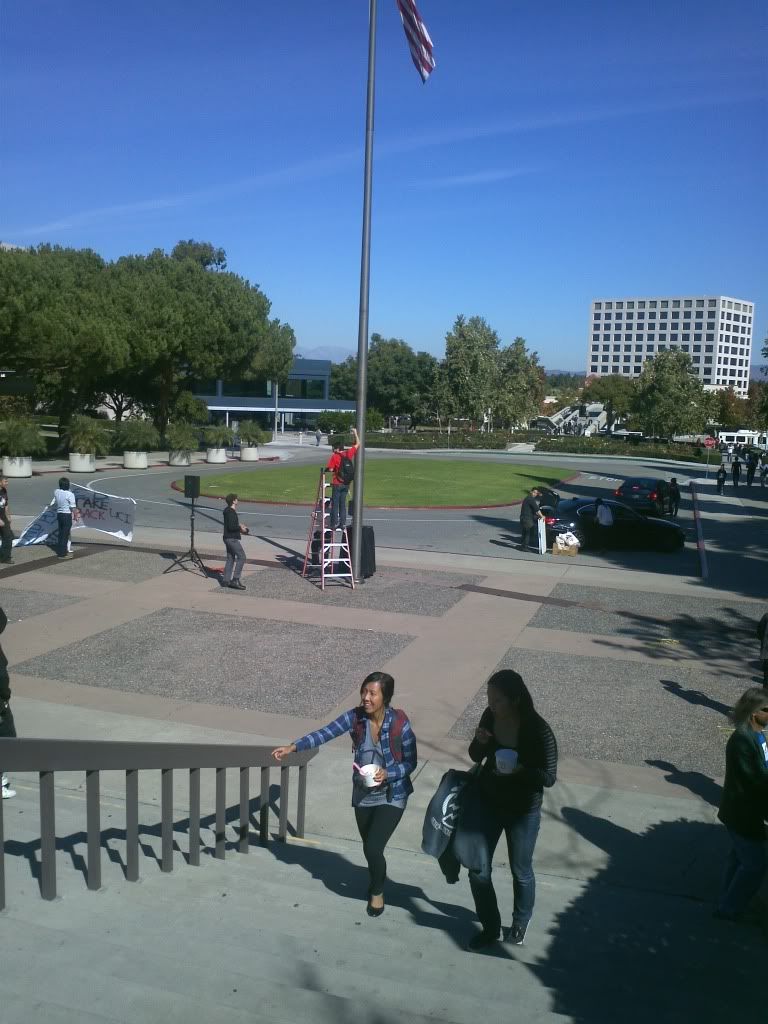
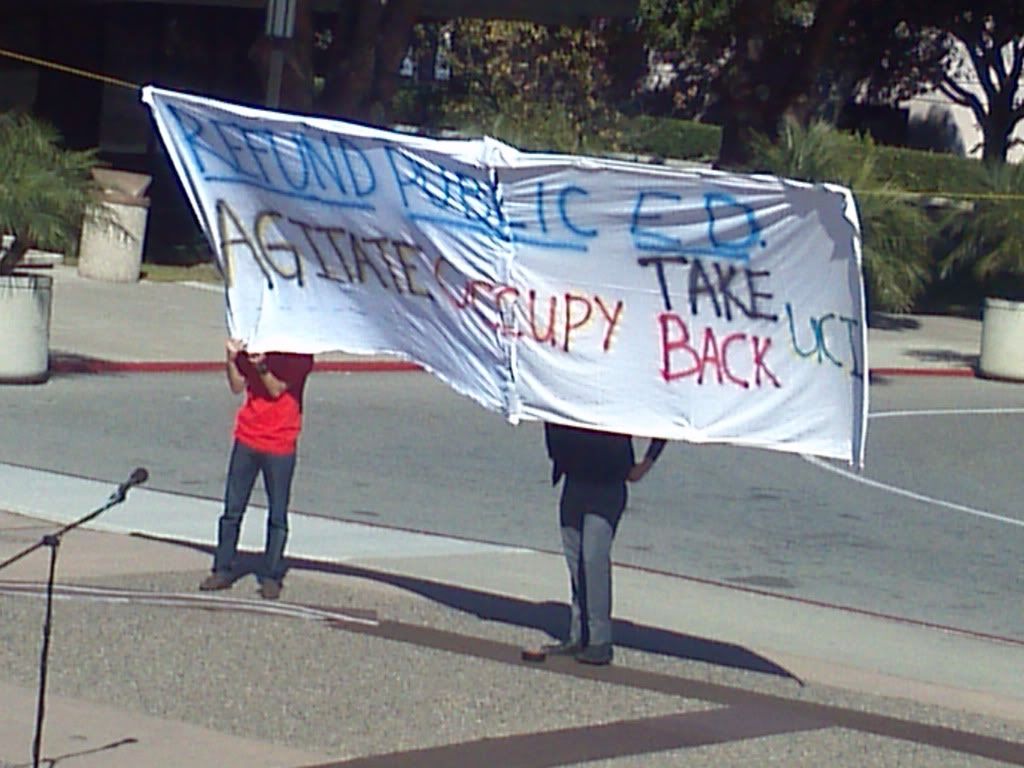
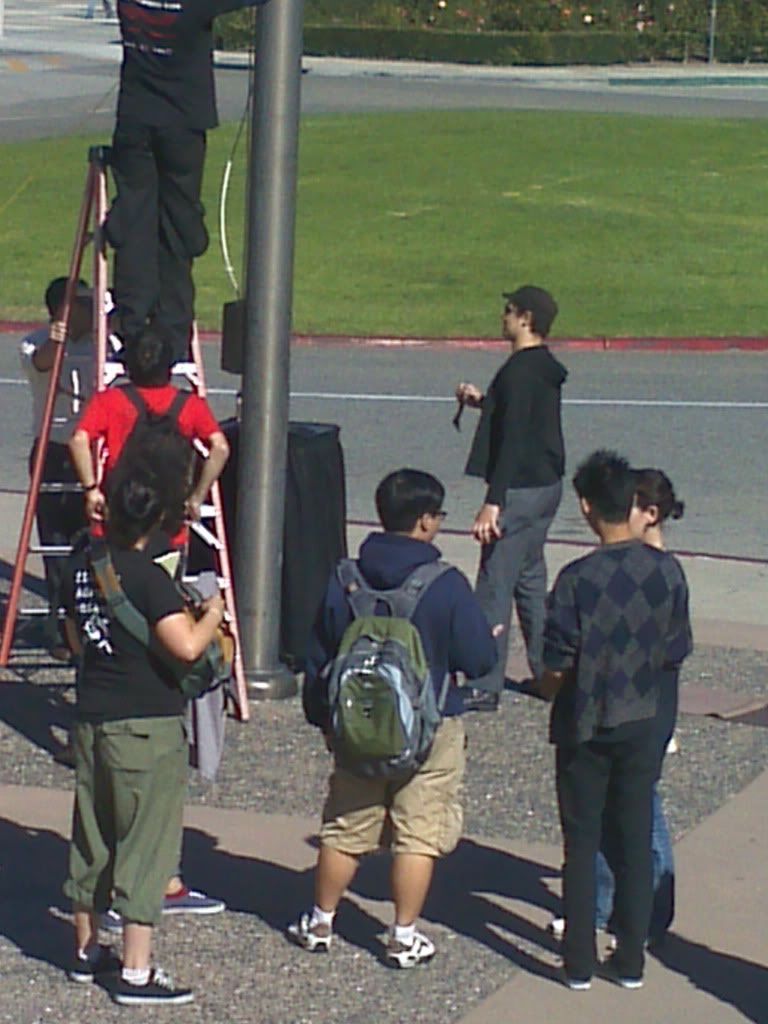
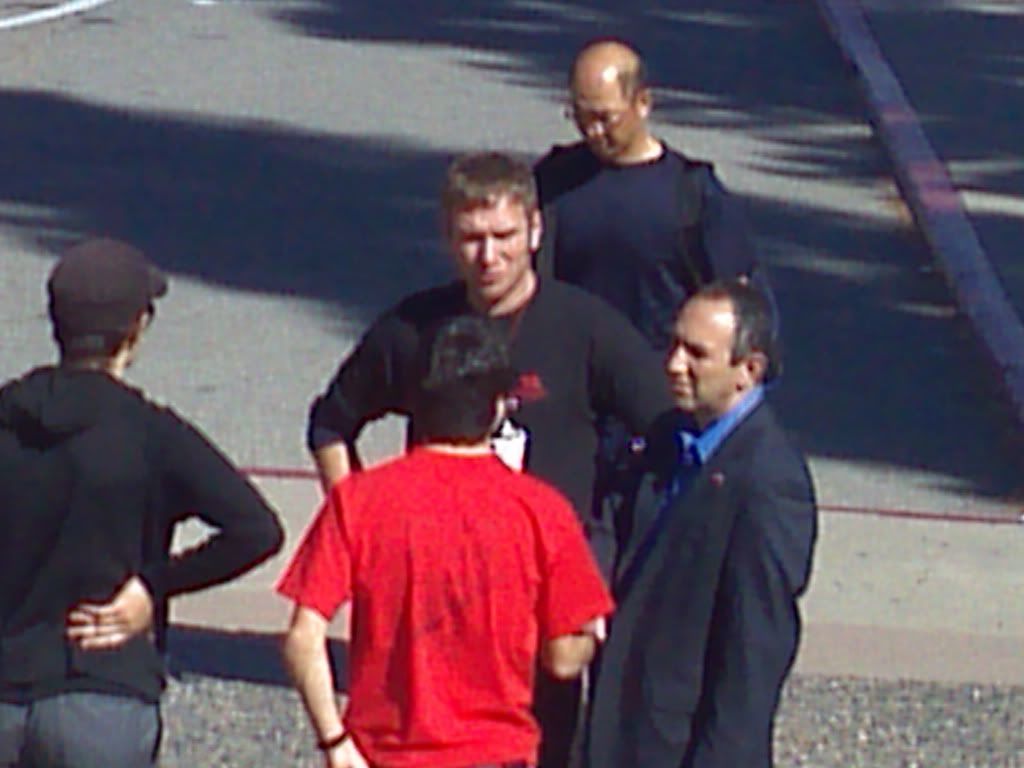
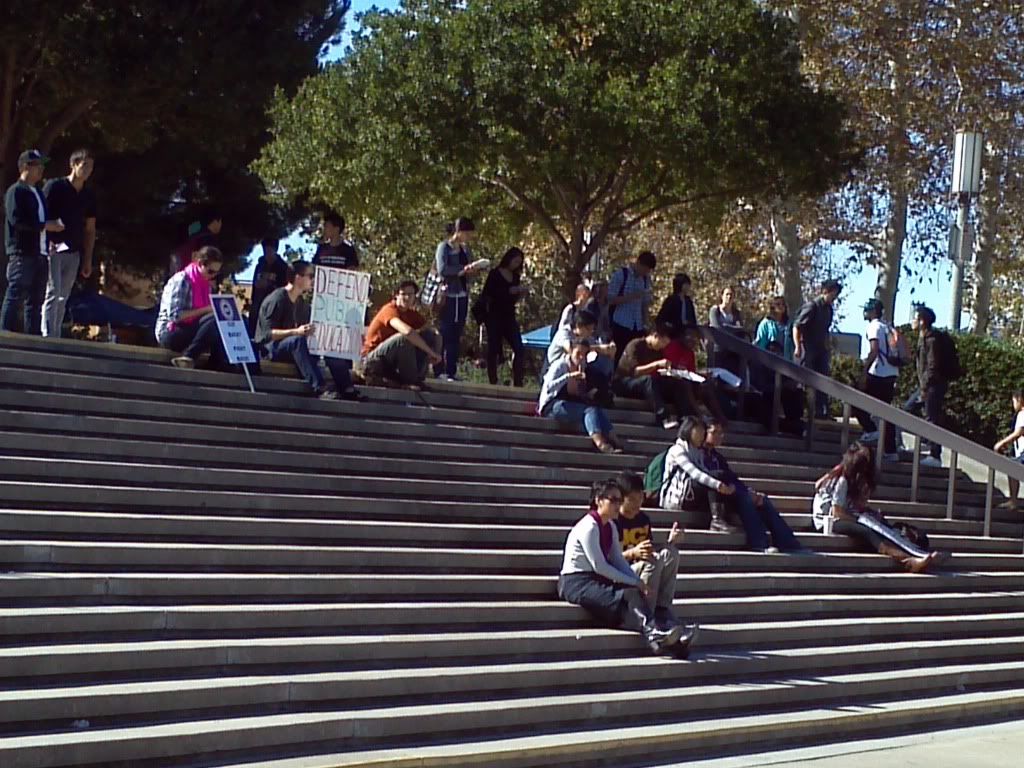
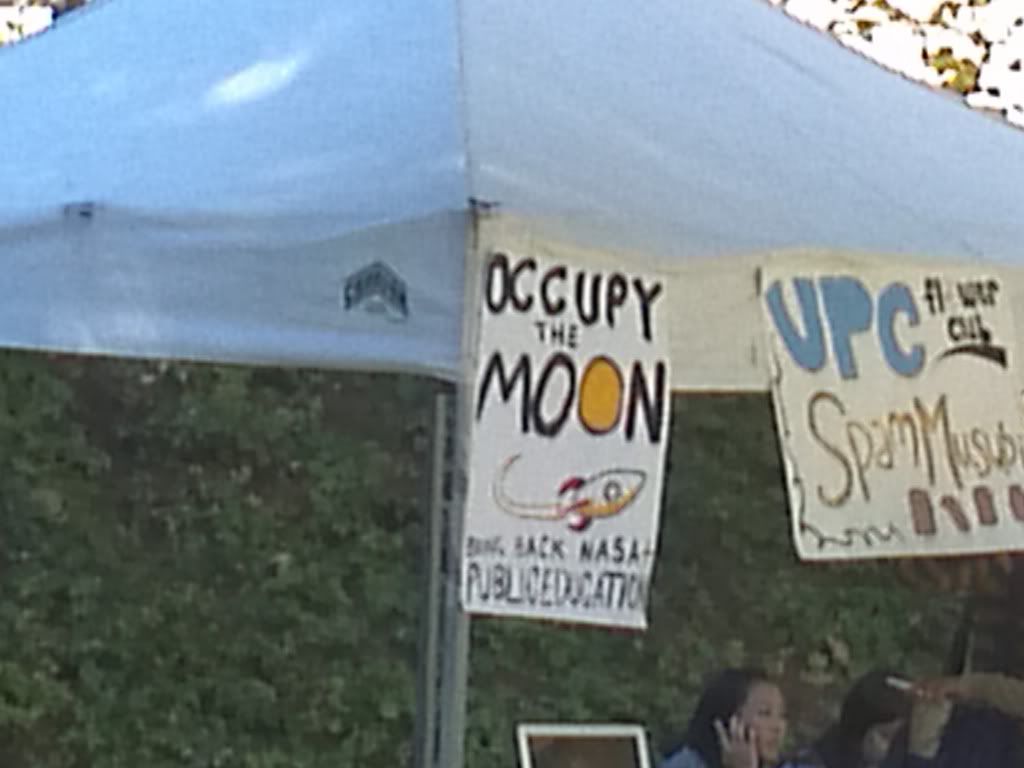
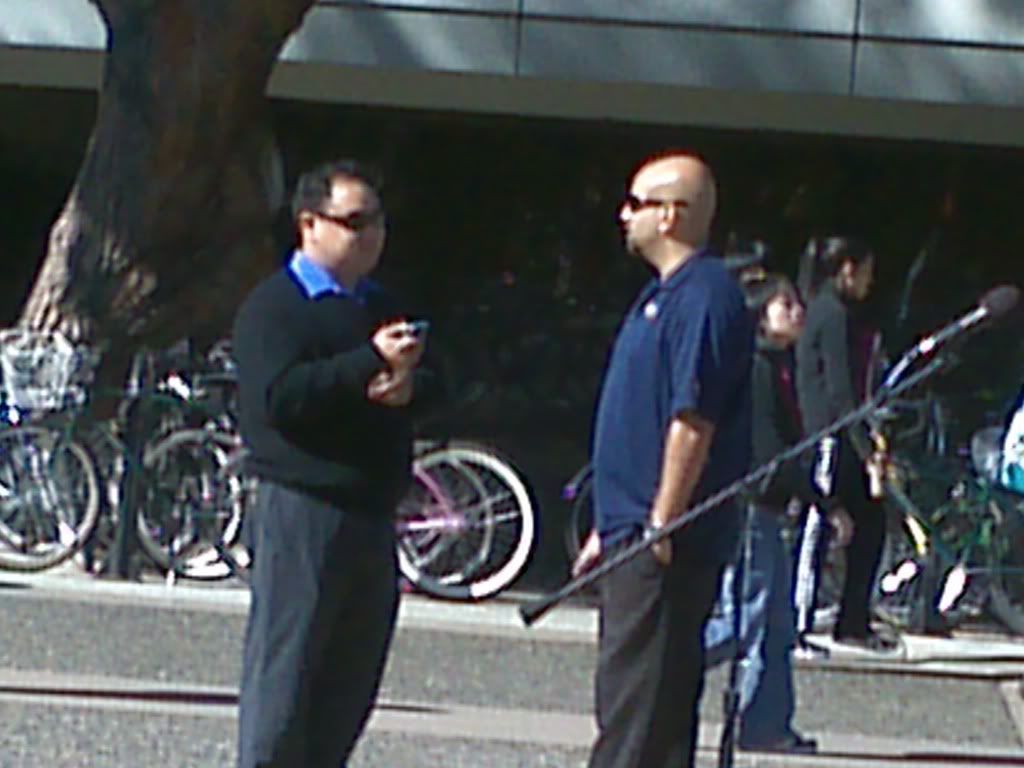
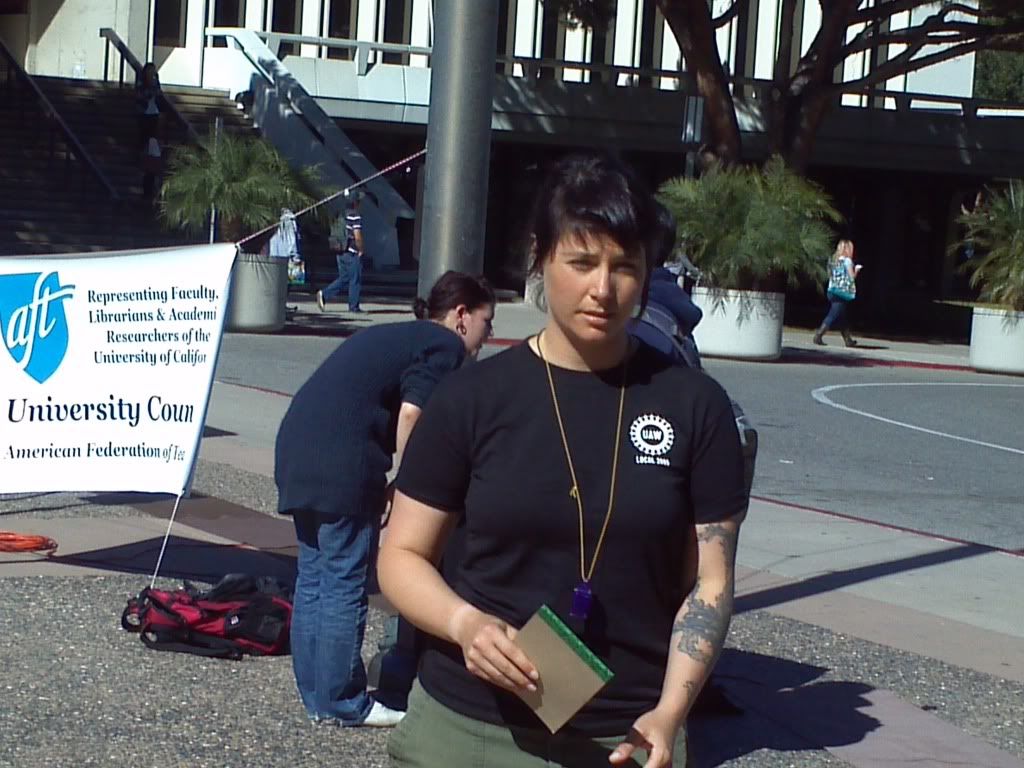
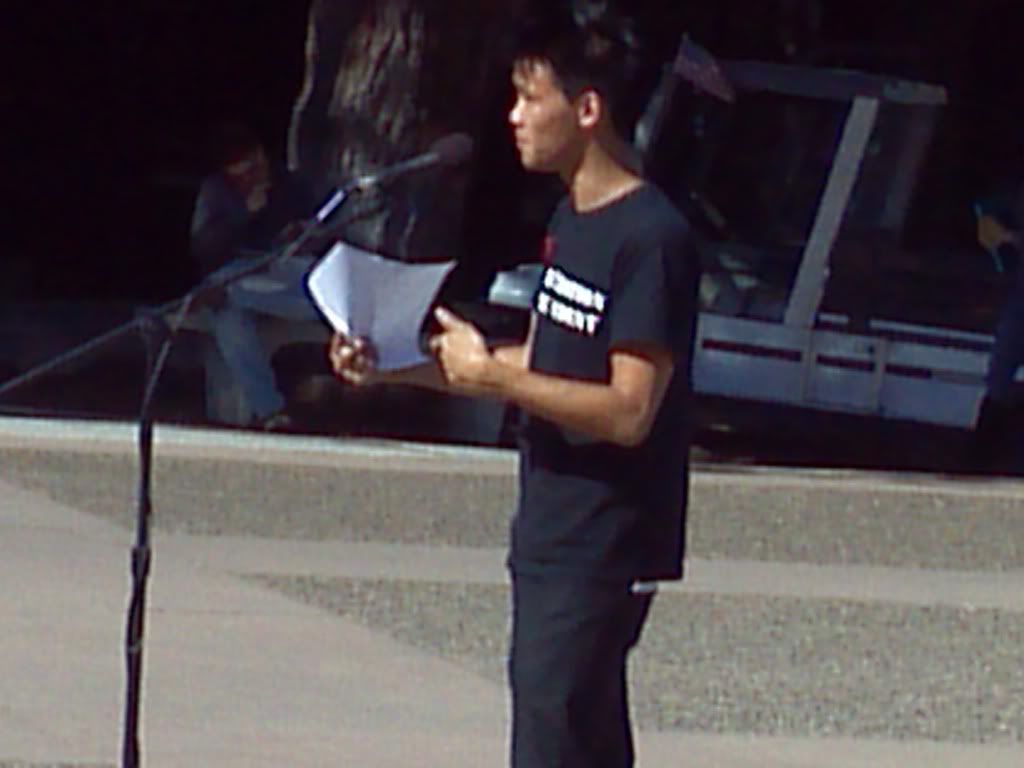
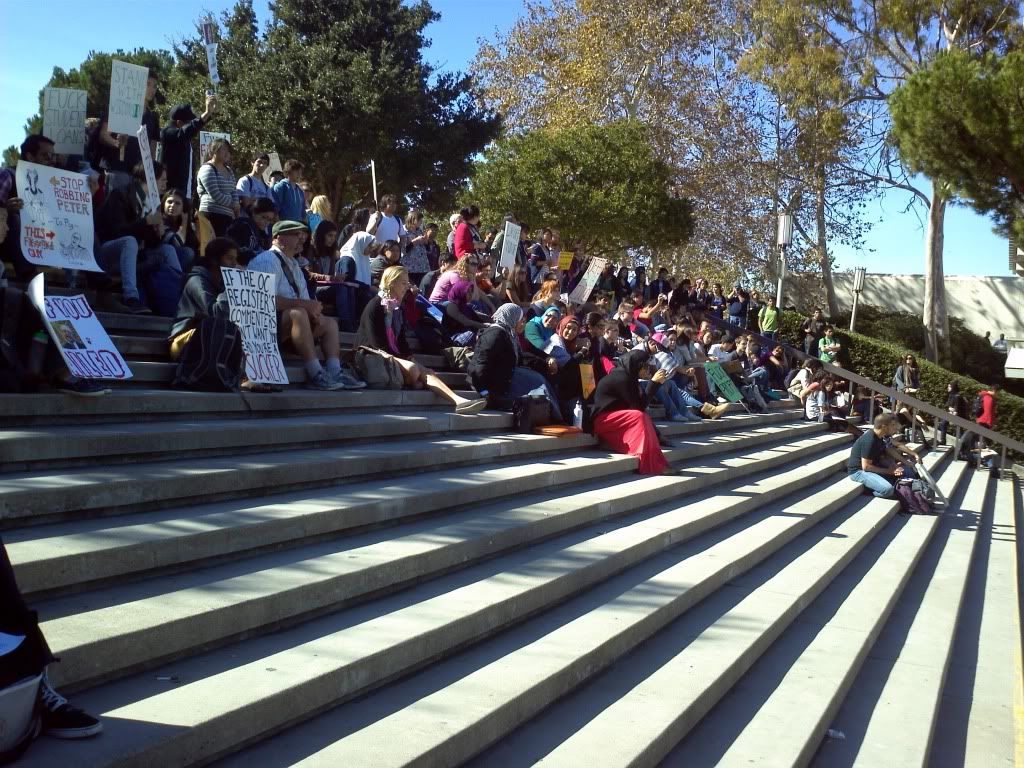
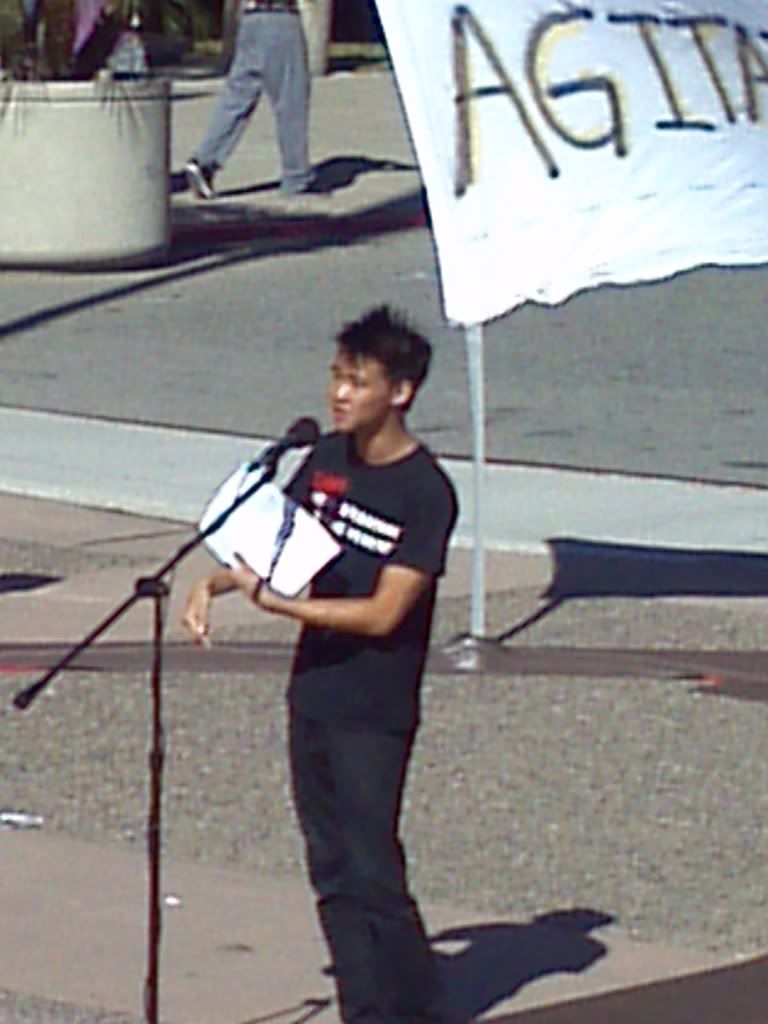
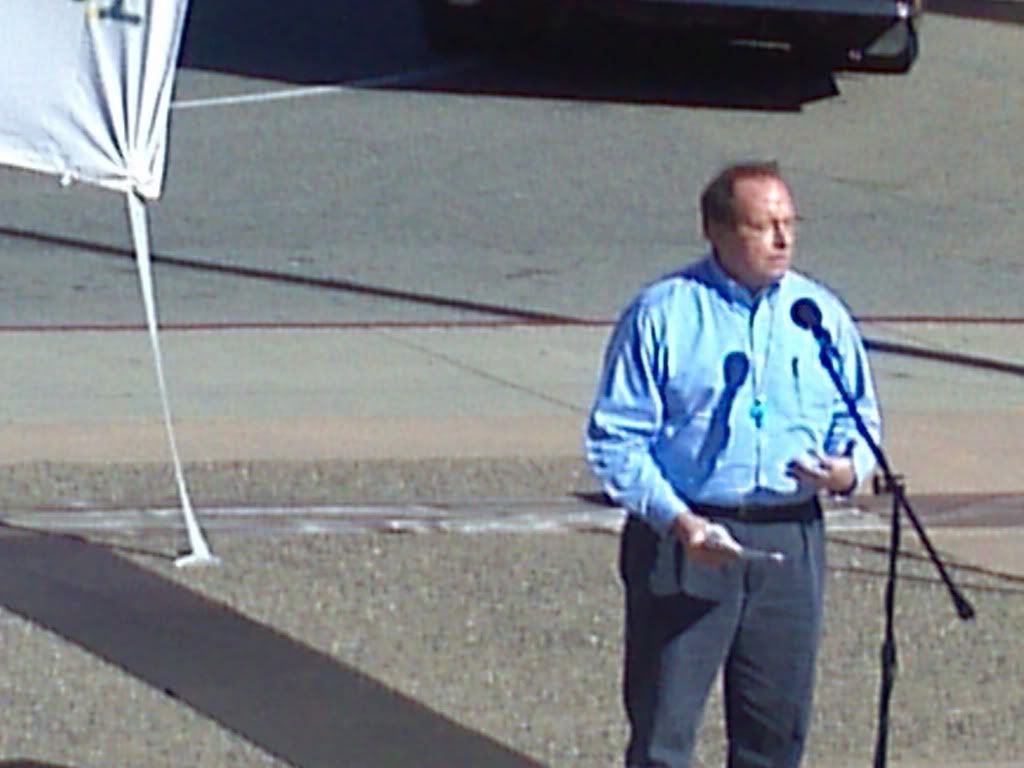
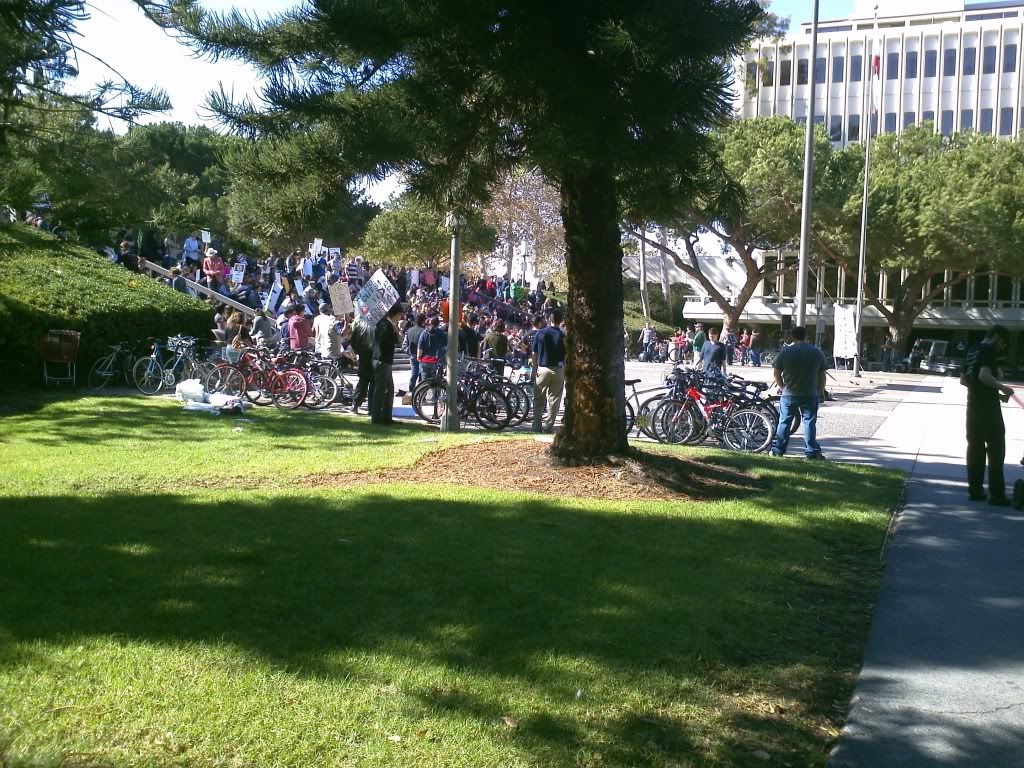
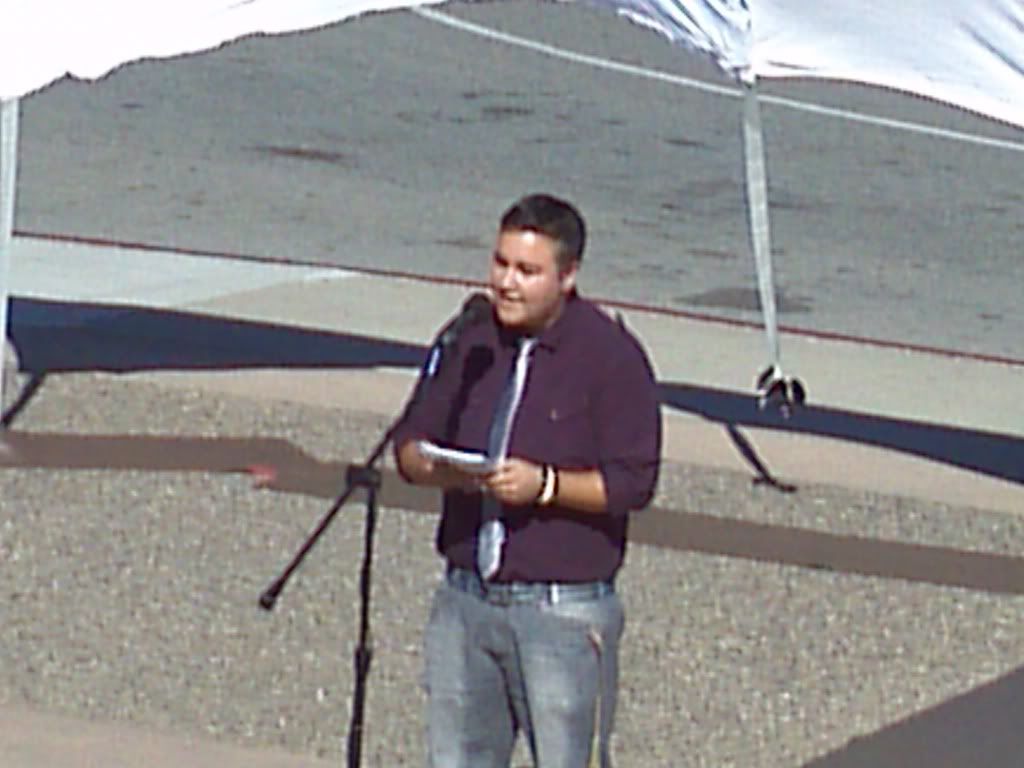
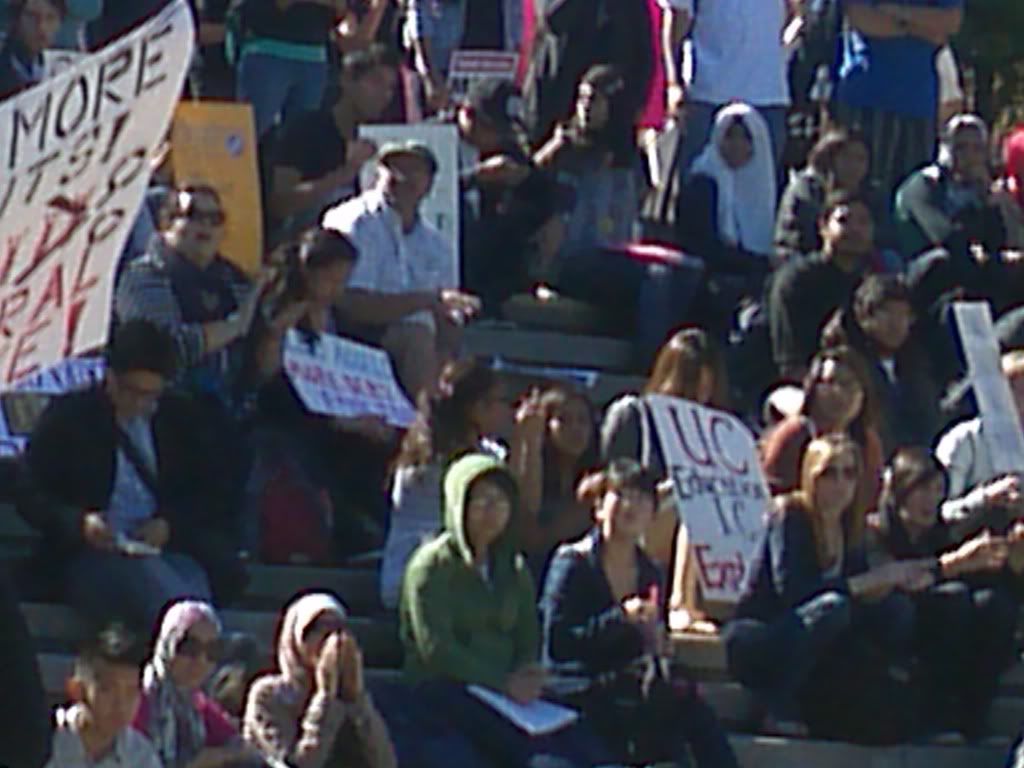
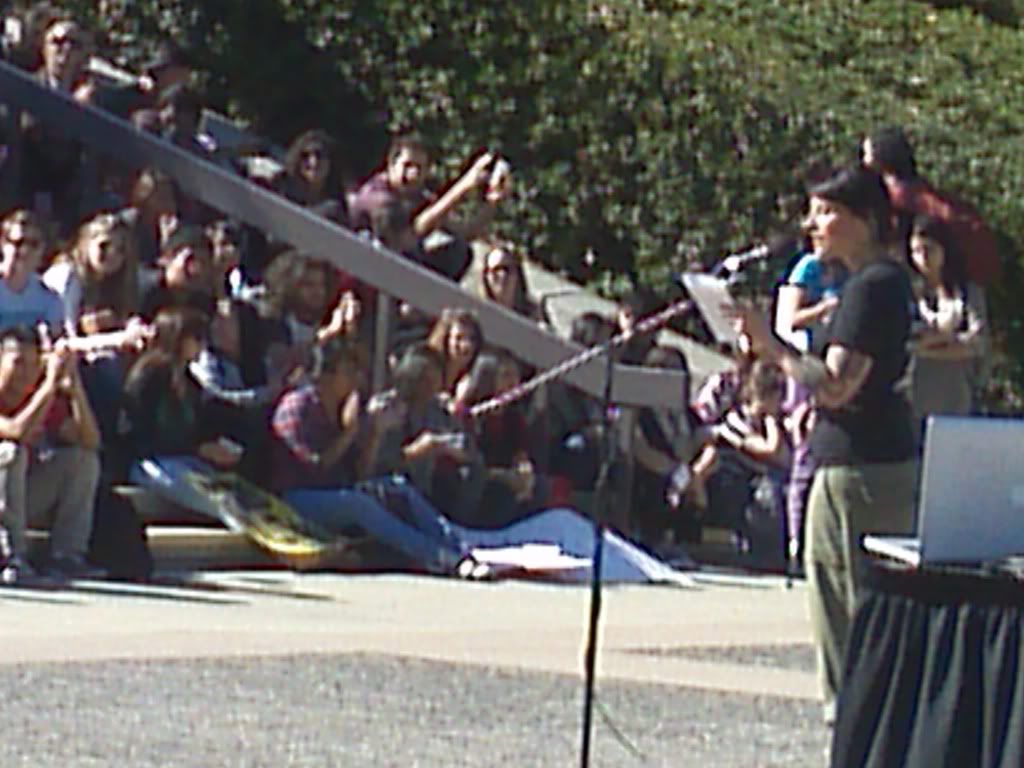
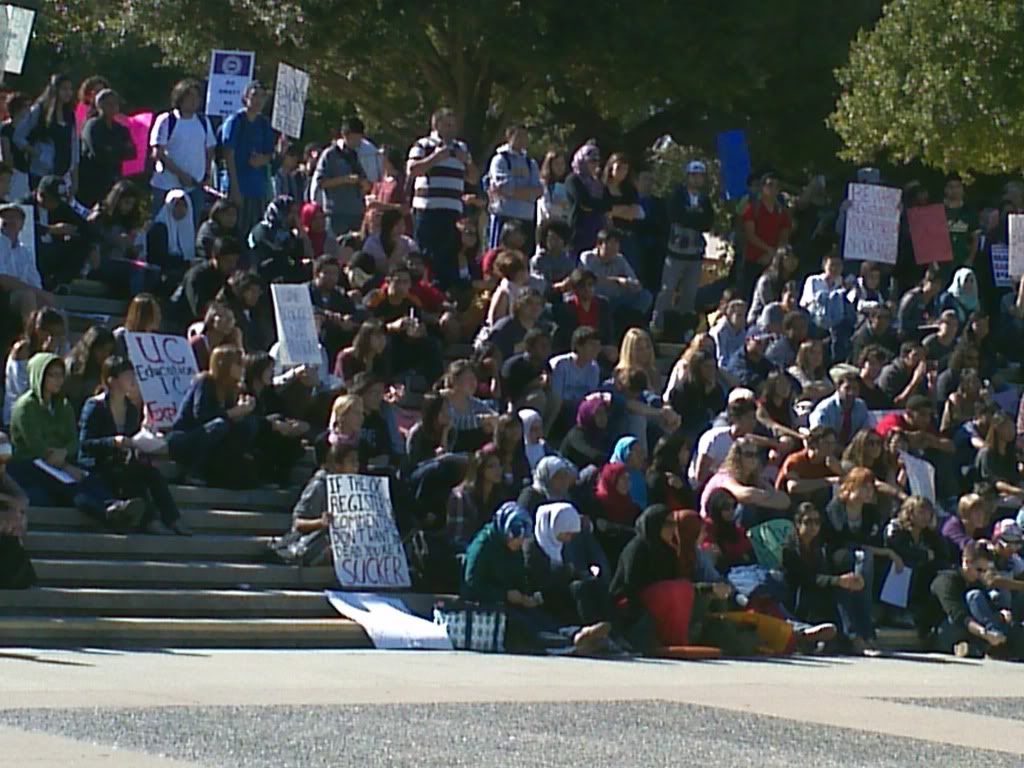
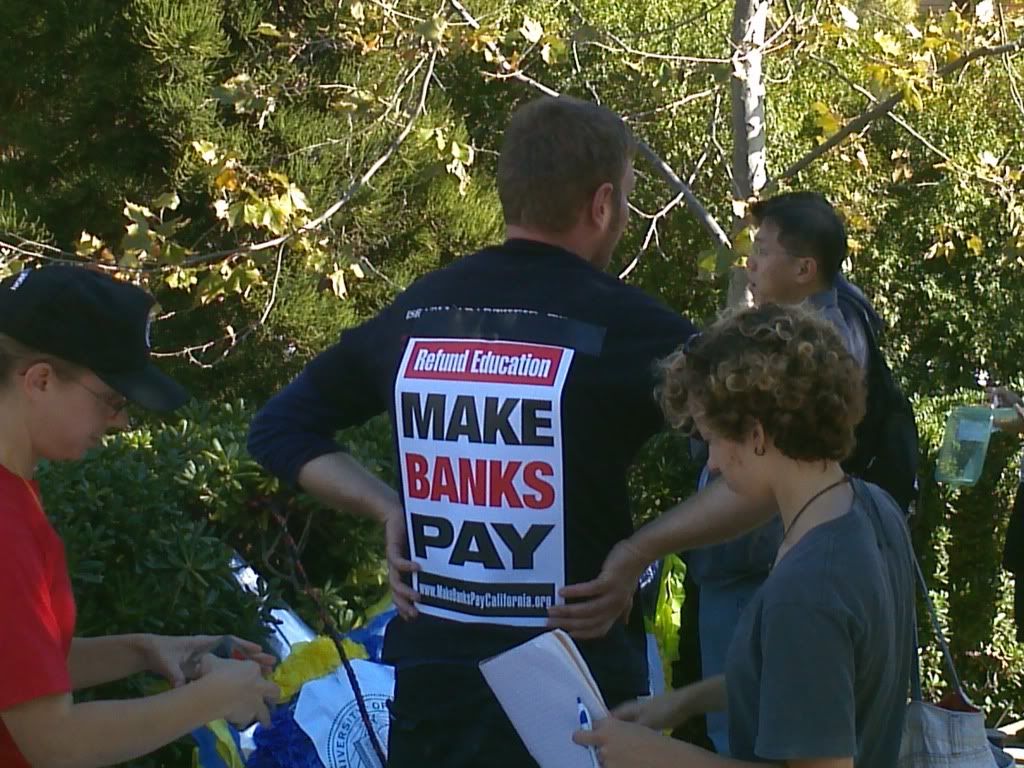
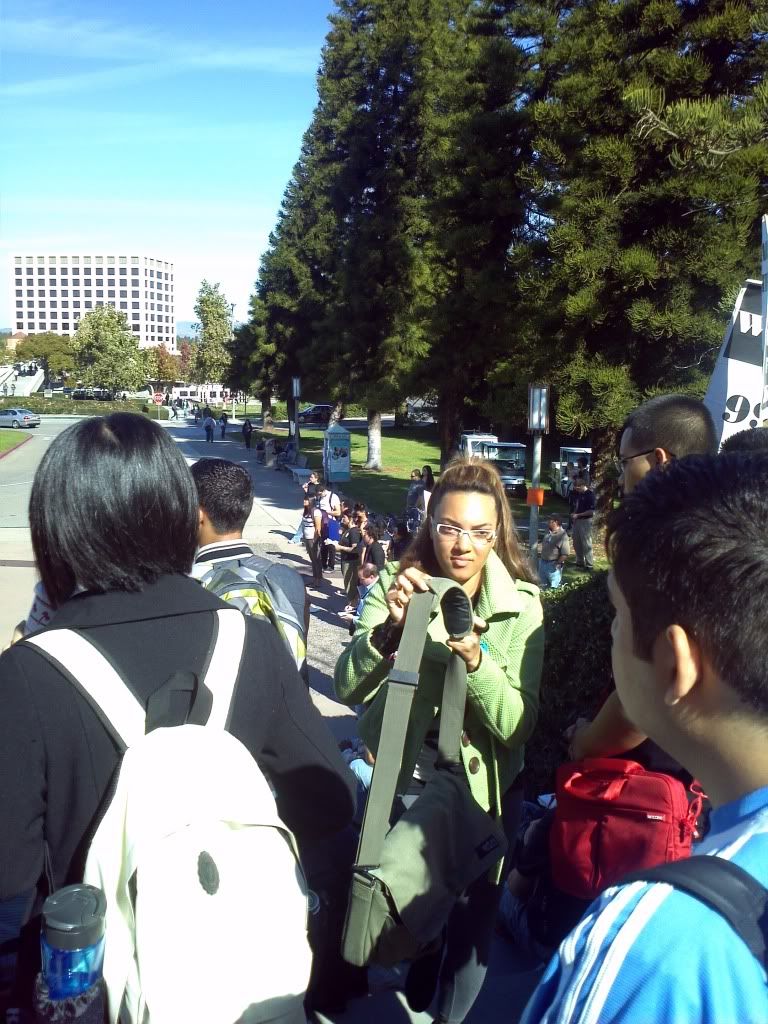
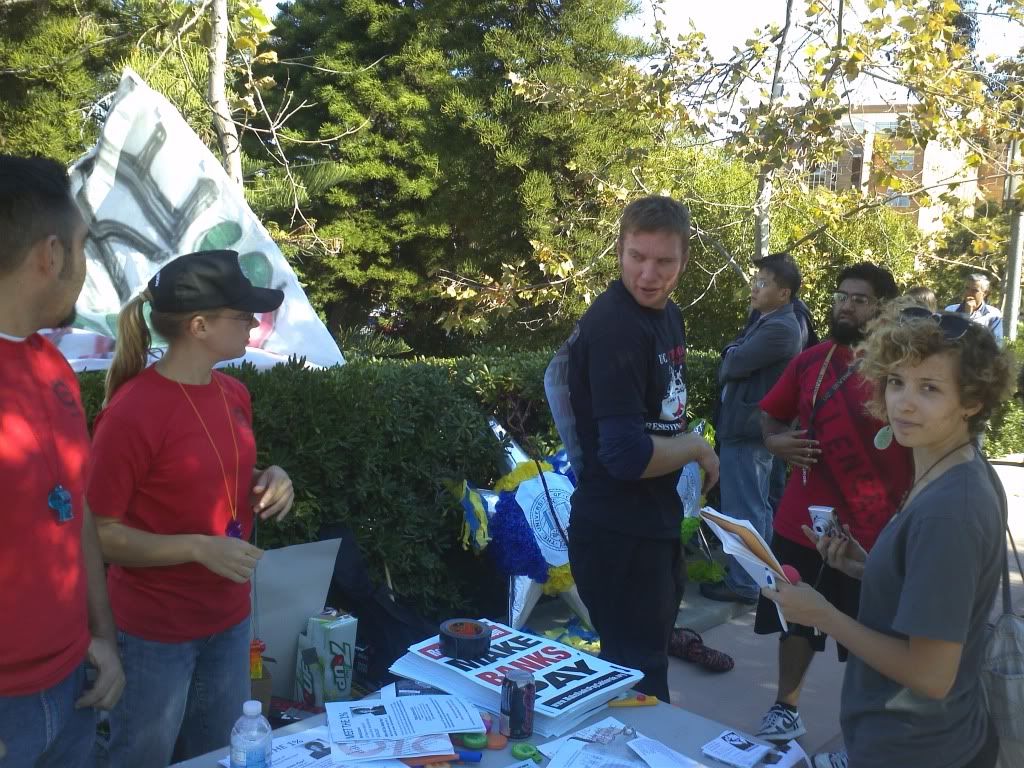
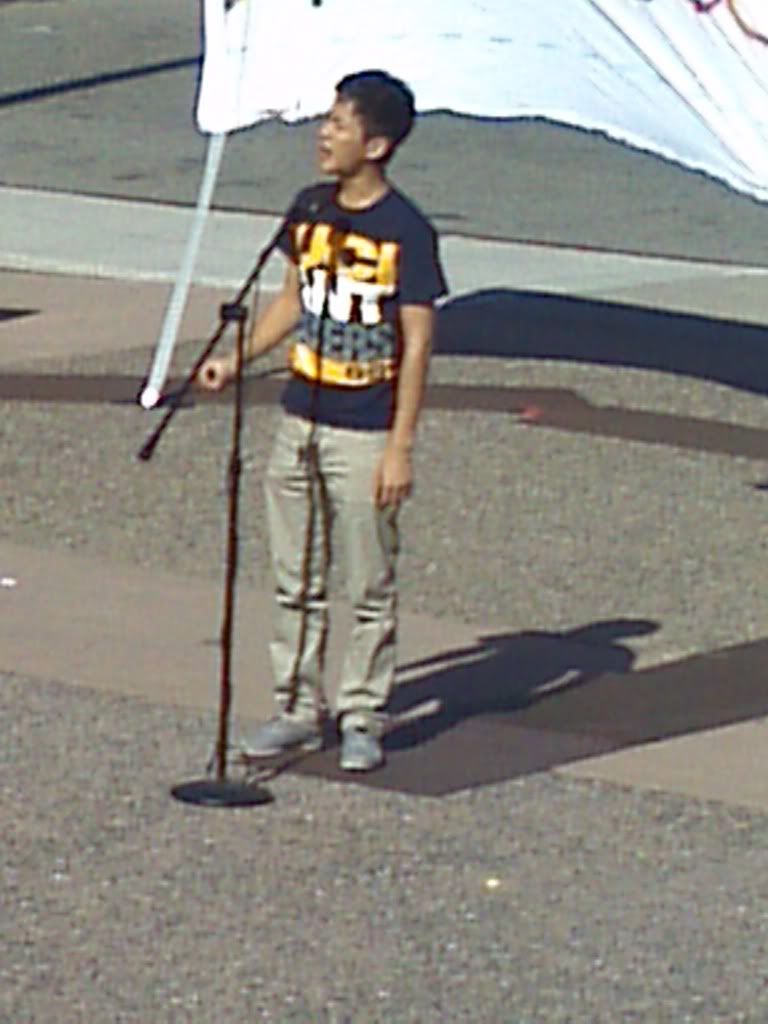
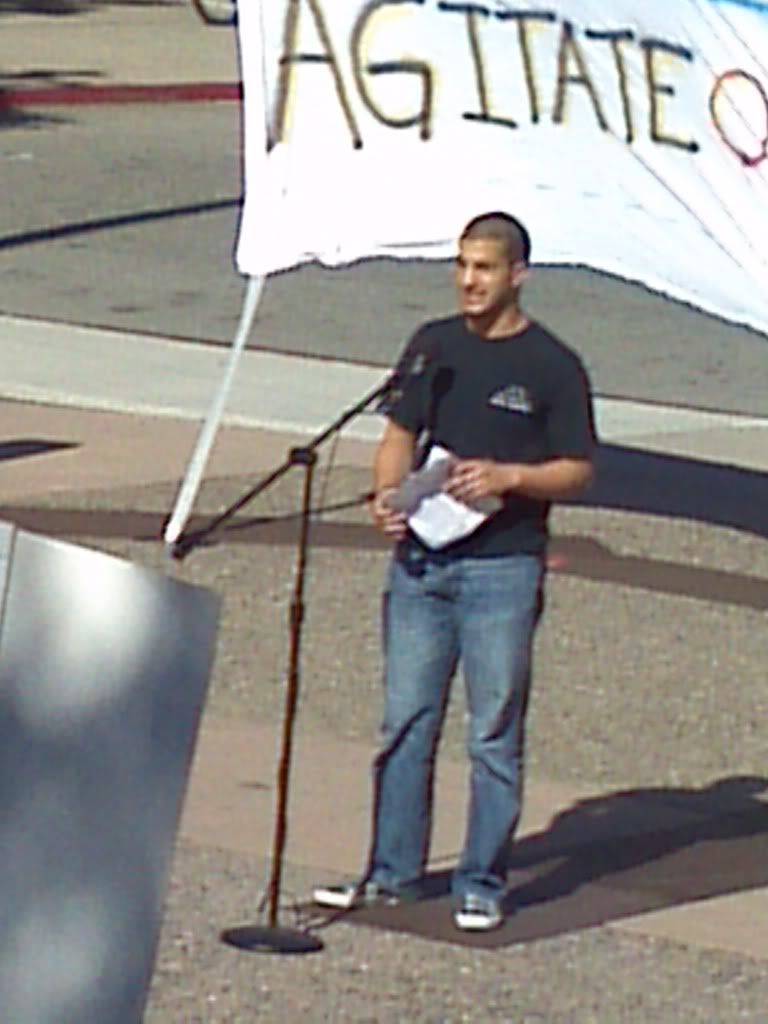
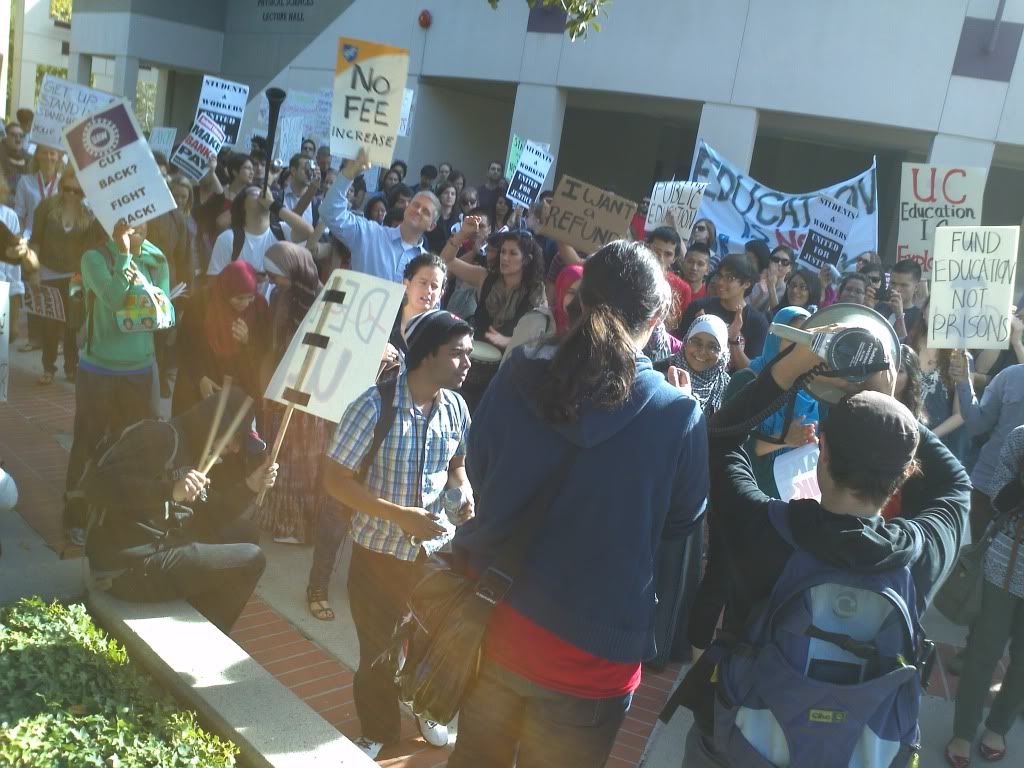
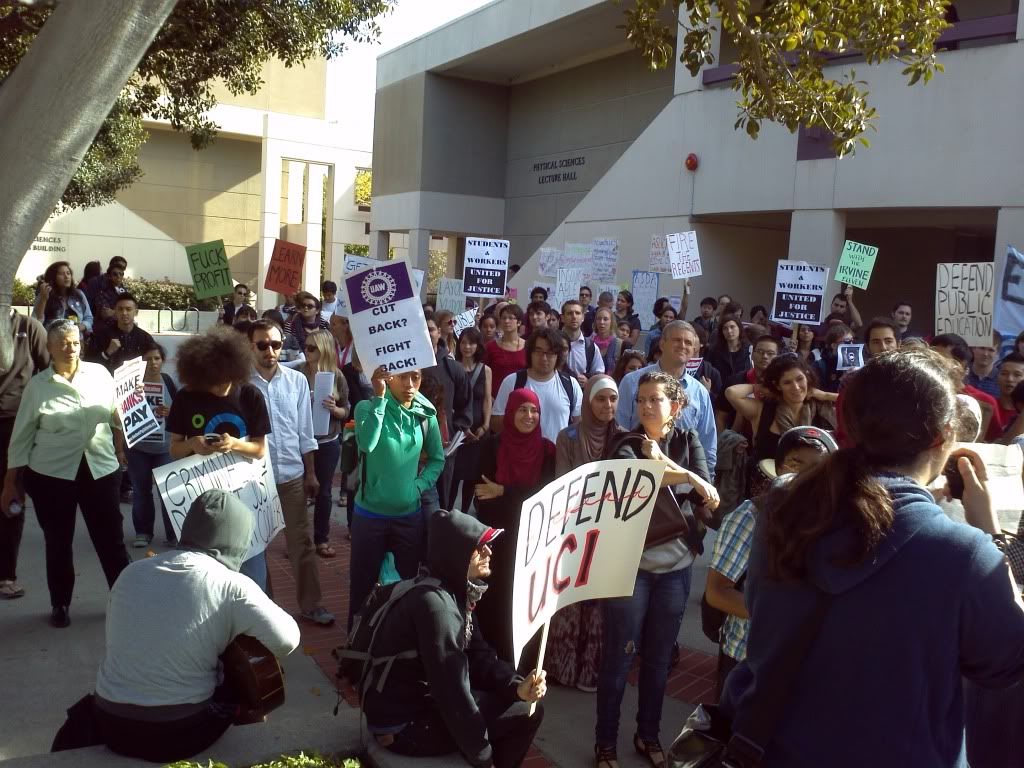
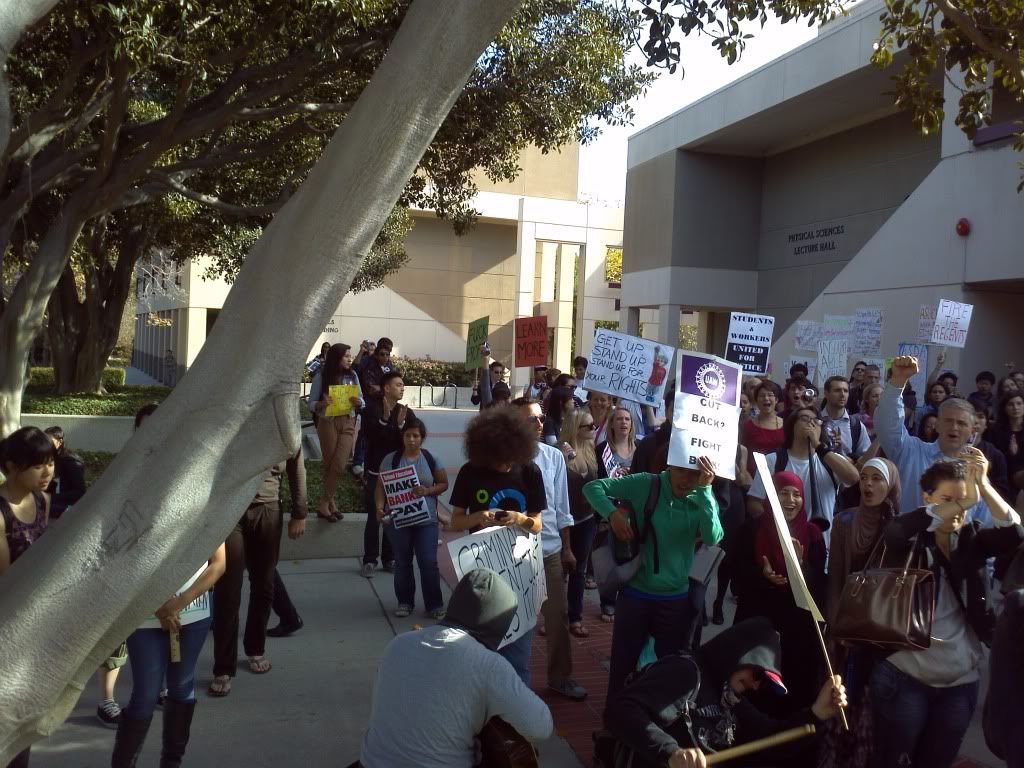
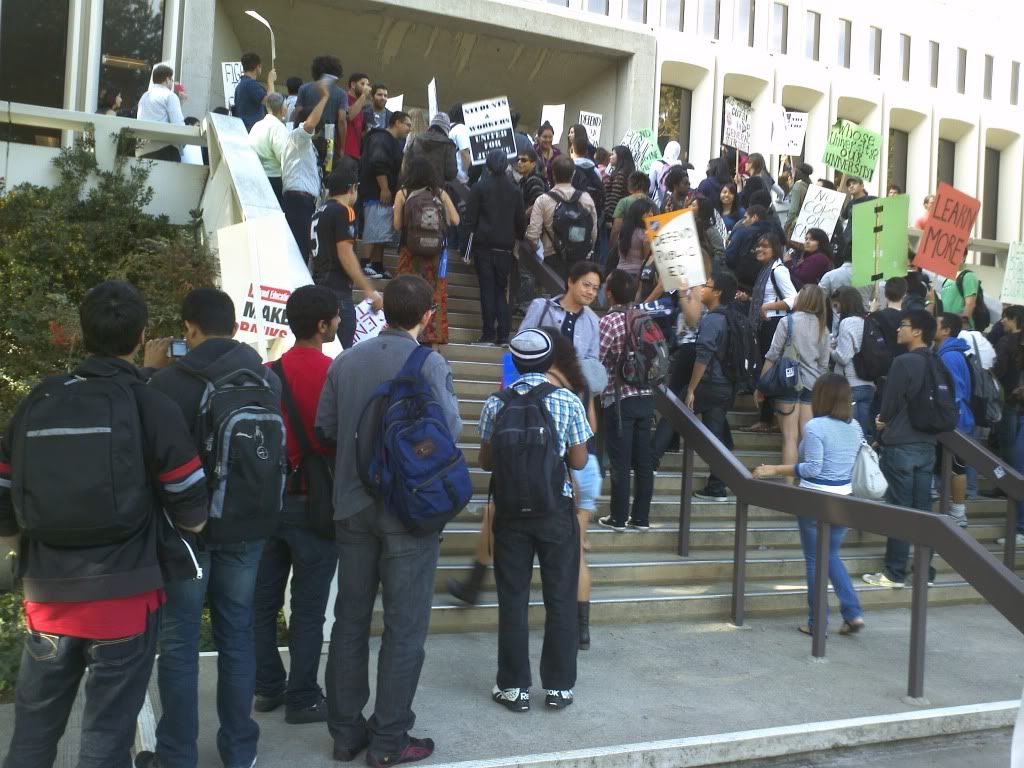
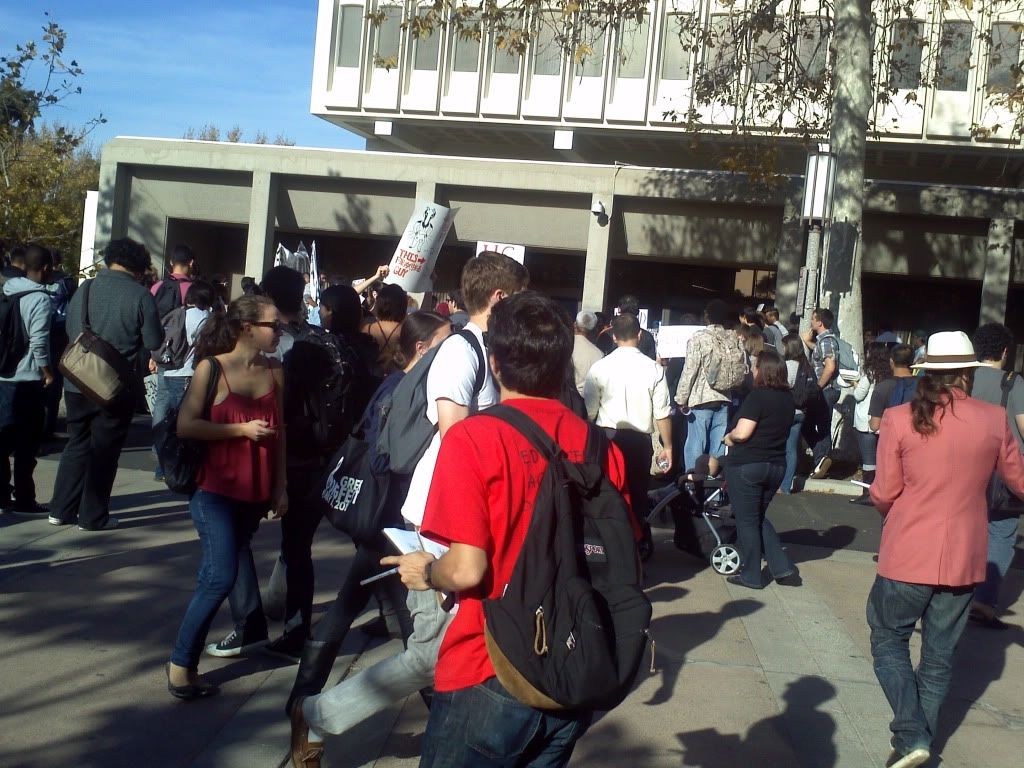
Photos of the November 9th rally in support of public education in Irvine
In response to proposed tuition increases, protests took place across the UC system. For more information about the current situation, I would recommend UC Santa Cruz's website. The UCI protest didn't have the spectacular dimensions seen at UCLA or Berkeley. We stayed on campus, and didn't attempt anything ambitious as an encampment, but we managed to have a fairly successful protest. We estimate that we probably had about 600 people involved in the event over a span of three hours. I thought that it might be more interesting if I offered some photos of the event, rather than narrate it. These photos are roughly in chronological order, moving from the set up of the rally, through the speakers, and onto the march. I was busy with the bullhorn, so I don't have as many pictures of the march itself. I'm going to let the pictures speak for themselves, but feel free to ask questions in the comments section


Wednesday, October 12, 2011
Some initial comments on demands
There has been a lot of talk about demands, lately. Most of this conversation comes out of the Occupy protests occurring in a variety of cities across the United States. A number of commentators have found the phenomenon confusing, claiming not to understand the goals of the movement or its methods. To tell the truth, a lot of these folks, most notably the mainstream news industry, are engaged in deliberate obfuscation. But some of these comments are coming from people who are committed to counter-systemic movements, such as Doug Henwood and Jodi Dean who have made some comments worth taking a look at. My views on the question are a little more ambiguous, primarily because of some of the misunderstandings about the role of demands on the part of those who oppose them, and because of some of the exaggeration of what demands can accomplish in regards to organizational clarity on the part of those who support them.
To open up the conversation, I want to make it clear that I support the idea of making demands. You can call those things any number of things, goals, policies, etc. Any serious social movement needs to develop a sense of what its goals are, what it's trying to accomplish, in the short term, the mid term, and the long term. Obviously, these projects aren't going to stay the same over time, but they provide a type of critical, cognitive mapping of where a movement is, and where it wants to be. You might notice that I haven't made any statements about 'speaking truth to power' here, or even 'speaking to power.' That's because demands are a way of organizing, of constructing 'constituent power' to use the language of Antonio Negri. Rather than talking to members of congress or the bourgeoisie, demands allow for movements to communicate with potential participants, as well a allowing for a healthy internal debate over the direction of the movement. They create the drive for projects, and allow for the success of those projects to be measured. Our militancy and collectivity create space for reform amongst constituted power, while our communications are designed to foster those forms of militancy and collectivity. Demands also can separate a movement from very problematic elements who want to appropriate it. Exclusion may sound bad until you realize that the people being excluded are racists, conspiracy theorists, and libertarians, folks who are going to derail any social justice movement.
The demands made surrounding the spring sit in in 2009 is a good example of how demands can be used. (see here for a listing of the demands.) The demands created by the group to link the demand for a public university to a variety of struggles on the university, making both immediate and long term demands. They effectively challenged the economist interpretation of the movement by the local paper, by linking the struggle to fights against racism, militarism, and workers' struggles occurring on the campus. More significantly, the demands created a lot of buzz on campus, and the various demands were discussed extensively by students and faculty. We can effectively see a moment where demands allowed for a shift in political conversations, and took a small action (albeit a very militant and energetic one) and made it the talk of the campus. It also managed to express the goals of the movement in a much more accessible and simple language than the often overwrought occupation manifestos of northern California, creating a non-sectarian and intersectional political project for the movement. Finally, it set out a wide variety of demands, some which were very realizable such as the demand for unisex bathrooms, but also demands for larger structural changes that are not immediate available for appropriation. In effect, it created demands that could create immediate victories, but without the illusion that those immediate victories were sufficient for the movement to succeed.
At the same time, I think that there are some mistakes made by those who put their faith in demands. Most significantly, this is a new movement, and the political goals of that movement have to be created through the struggles of that movement. They can't be the creation of a few folks in a small room, to paraphrase Rosa Luxemburg. I also think that it's a mistake to think that any genuinely political movement can be made immediately coherent with a few slogans or a couple manifestos. As Adorno and others would point out, there's nothing radical about common sense, and therefore, any radical movement is going to seem strange and unfamiliar to the common-sense of our society, which largely operates on hegemonic norms. To give a practical example, many of the demands for the action discussed above, often confused and alienated the students, particularly demands for non-economic concerns. Additionally, while we want to make our political projects accessible to potential members, we don't necessarily want to make our actions immediately accessible to dominant institutional structures. Confusion frequently allows for us to accomplish better actions, ones that create larger effects, that attract more attention, that challenge the expectations of everyday life. In effect, movements need to make themselves coherent to build themselves, but actions frequently benefit from forms of innovation and confusion. Moreover, most real social movements constitute and represent themselves in struggle. 'Demandless' events can contribute to that process.
To open up the conversation, I want to make it clear that I support the idea of making demands. You can call those things any number of things, goals, policies, etc. Any serious social movement needs to develop a sense of what its goals are, what it's trying to accomplish, in the short term, the mid term, and the long term. Obviously, these projects aren't going to stay the same over time, but they provide a type of critical, cognitive mapping of where a movement is, and where it wants to be. You might notice that I haven't made any statements about 'speaking truth to power' here, or even 'speaking to power.' That's because demands are a way of organizing, of constructing 'constituent power' to use the language of Antonio Negri. Rather than talking to members of congress or the bourgeoisie, demands allow for movements to communicate with potential participants, as well a allowing for a healthy internal debate over the direction of the movement. They create the drive for projects, and allow for the success of those projects to be measured. Our militancy and collectivity create space for reform amongst constituted power, while our communications are designed to foster those forms of militancy and collectivity. Demands also can separate a movement from very problematic elements who want to appropriate it. Exclusion may sound bad until you realize that the people being excluded are racists, conspiracy theorists, and libertarians, folks who are going to derail any social justice movement.
The demands made surrounding the spring sit in in 2009 is a good example of how demands can be used. (see here for a listing of the demands.) The demands created by the group to link the demand for a public university to a variety of struggles on the university, making both immediate and long term demands. They effectively challenged the economist interpretation of the movement by the local paper, by linking the struggle to fights against racism, militarism, and workers' struggles occurring on the campus. More significantly, the demands created a lot of buzz on campus, and the various demands were discussed extensively by students and faculty. We can effectively see a moment where demands allowed for a shift in political conversations, and took a small action (albeit a very militant and energetic one) and made it the talk of the campus. It also managed to express the goals of the movement in a much more accessible and simple language than the often overwrought occupation manifestos of northern California, creating a non-sectarian and intersectional political project for the movement. Finally, it set out a wide variety of demands, some which were very realizable such as the demand for unisex bathrooms, but also demands for larger structural changes that are not immediate available for appropriation. In effect, it created demands that could create immediate victories, but without the illusion that those immediate victories were sufficient for the movement to succeed.
At the same time, I think that there are some mistakes made by those who put their faith in demands. Most significantly, this is a new movement, and the political goals of that movement have to be created through the struggles of that movement. They can't be the creation of a few folks in a small room, to paraphrase Rosa Luxemburg. I also think that it's a mistake to think that any genuinely political movement can be made immediately coherent with a few slogans or a couple manifestos. As Adorno and others would point out, there's nothing radical about common sense, and therefore, any radical movement is going to seem strange and unfamiliar to the common-sense of our society, which largely operates on hegemonic norms. To give a practical example, many of the demands for the action discussed above, often confused and alienated the students, particularly demands for non-economic concerns. Additionally, while we want to make our political projects accessible to potential members, we don't necessarily want to make our actions immediately accessible to dominant institutional structures. Confusion frequently allows for us to accomplish better actions, ones that create larger effects, that attract more attention, that challenge the expectations of everyday life. In effect, movements need to make themselves coherent to build themselves, but actions frequently benefit from forms of innovation and confusion. Moreover, most real social movements constitute and represent themselves in struggle. 'Demandless' events can contribute to that process.
Sunday, September 11, 2011
University of California-Irvine lays off 1/3 of its janitors
I'm going to try to keep this posting relatively brief. Over the past few years, there has been a fairly significant labor struggle occurring at University of California-Irvine. UCI is the last of the UC system to use outsourced labor. At one point, both the landscape and the janitorial workers were outsourced, but after a long and fairly painful struggle on the part of an alliance of workers, AFSCME 3299, and the Worker-Student Alliance, the landscape workers were insourced as union employees. The struggle then turned to insource the janitorial workers, a struggle that continues to this day. A number of the significant actions of the budget cuts struggles at UCI focused on these struggles, and the political alliance at the heart of the insourcing campaign played a significant role in pushing those struggles forward. However, the campaign has been blockaded by the administration through its use of dissemblance and deception, at times, claiming that the workers were in the process of being insourced, while continuing the policies of outsourcing labor, at times through the use of rumor and innuendo to break up political alliances in solidarity with the workers. (In all fairness, the activist community has made significant contributions to these fractures on their own.) Additionally, the university has threatened to use the largely Latino work force's legal status as a way of stopping the calls for insourcing, posing legal and INS sanctions as the consequence of making these demands. (This calls for a longer conversation that I can't deal with at the moment.)
I wanted to open with that context to establish that the university's actions around the janitorial workers can't be simply understood in some sort of reductivist economic context. They are defined by the long struggle that started long before the existence of the current economic crisis. Recently it looked like there may be the possibility of a breakthrough in these negotiations. The university had sent a set of proposals to the union for insourcing the workers. To be sure, the proposal was terrible, and was part of a long series of university proposals that were never followed through on, but it was the first time that a plan was actually put into writing. Unfortunately, the university followed that proposal with a set of lay offs that went into effect last Tuesday, laying of 49 workers, about one third of the janitorial workforce. Within this context, it's difficult to see this action as one in a long series of betrayals on the part of the university to its lowest paid workers. If these lay-offs are allowed to stay in place, the already heavily burdened janitorial workforce will have to take on more work, creating health and safety concerns for both the workers and the entire university community. Even before the lay-offs, labs and classrooms were cleaned infrequently, and the loss of more workers is bound to make the situation even worse.
AFSCME has some good information on the health and safety issues that I can put up if folks are interested, but at a basic level, we should simply fight these lay offs out of a solidarity with our fellow workers, and as a fight against the racism of the university. Please write Chancellor Michael Drake at chancellor@uci.edu or call his office at (949) 824-5111 to protest the recent lay-offs and to call for the insourcing of all UCI janitorial workers without preconditions.
I wanted to open with that context to establish that the university's actions around the janitorial workers can't be simply understood in some sort of reductivist economic context. They are defined by the long struggle that started long before the existence of the current economic crisis. Recently it looked like there may be the possibility of a breakthrough in these negotiations. The university had sent a set of proposals to the union for insourcing the workers. To be sure, the proposal was terrible, and was part of a long series of university proposals that were never followed through on, but it was the first time that a plan was actually put into writing. Unfortunately, the university followed that proposal with a set of lay offs that went into effect last Tuesday, laying of 49 workers, about one third of the janitorial workforce. Within this context, it's difficult to see this action as one in a long series of betrayals on the part of the university to its lowest paid workers. If these lay-offs are allowed to stay in place, the already heavily burdened janitorial workforce will have to take on more work, creating health and safety concerns for both the workers and the entire university community. Even before the lay-offs, labs and classrooms were cleaned infrequently, and the loss of more workers is bound to make the situation even worse.
AFSCME has some good information on the health and safety issues that I can put up if folks are interested, but at a basic level, we should simply fight these lay offs out of a solidarity with our fellow workers, and as a fight against the racism of the university. Please write Chancellor Michael Drake at chancellor@uci.edu or call his office at (949) 824-5111 to protest the recent lay-offs and to call for the insourcing of all UCI janitorial workers without preconditions.
Wednesday, February 2, 2011
On the convening a grand jury for the Irvine 11
I'm going to get back to the cultural and literary criticism that I usually produce, but the current events of my town have intervened again. The large and vibrant protest movement of last year has produced criminal charges this year. The first charges were placed against the participants in the sit-in in the administration building last year. That group, along with a pair of outside supporters, has been put up on a variety of misdemeanor charges on the part of the Orange County District Attorney's office. For more information, look here. These charges were seen as a fairly substantial attack on the right to protest and freedom of speech at the University. However, the same office has just has subpoenaed six UCI Muslim students and compelled them to testify before a grand jury with the possibility of felony charges coming out of the process. These students will be potentially charged with felony conspiracy charges for a demonstration that briefly interrupted a speaker at a public event, a common and perhaps even banal protest tactic at the university. In addition, these criminal charges are on top of a set of administrative punishments on the part of the University of California-Irvine. Here are my thoughts on the university's action against the MSU (who was uninvolved as a group in the protest.)
To give a sense of the mildness of the protest, I was involved in a protest of UN Ambassador Bill Richardson in the late 1990's. Richardson was speaking at the university to drum up support for a new attack on Iraq on behalf of the Clinton administration (for those who feel nostalgic for Clinton, his sanctions campaign led to the death of at least 600,000 Iraqi civilians.) For some reason, the organizers of the talk in the Humphrey building thought that 75-100 angry anti-sanctions protesters were going to sit back quietly and listen to Richardson advocate for the mass death of more Iraqis. Within a minute of the speech, the ambassador was drowned out by the protesters, and the speech was entirely shut down. I'm still proud of that event. Our disruption of the event along with the Ohio State protest cut through the pro-war propaganda of the administration and the news networks. Like the milder five minute protest of Israeli Ambassador by the Eleven, we effectively transformed a monologue into a real political dialogue with our actions. At the same time, we faced no school or criminal charges for these much more militant and disruptive tactics, and our protest was an official action on the part of our organization, the Progressive Student Organization. I don't think that it's a coincidence that our group of protesters, unlike the Irvine protesters, was almost exclusively white.
There are calls to support the Irvine 11. One can find a petition here. In addition, there are calls to send emails to the district attorney, Tony Rackauckas to drop the charges. Here is the email. tony.rackauckas@da.ocgov.c
To give a sense of the mildness of the protest, I was involved in a protest of UN Ambassador Bill Richardson in the late 1990's. Richardson was speaking at the university to drum up support for a new attack on Iraq on behalf of the Clinton administration (for those who feel nostalgic for Clinton, his sanctions campaign led to the death of at least 600,000 Iraqi civilians.) For some reason, the organizers of the talk in the Humphrey building thought that 75-100 angry anti-sanctions protesters were going to sit back quietly and listen to Richardson advocate for the mass death of more Iraqis. Within a minute of the speech, the ambassador was drowned out by the protesters, and the speech was entirely shut down. I'm still proud of that event. Our disruption of the event along with the Ohio State protest cut through the pro-war propaganda of the administration and the news networks. Like the milder five minute protest of Israeli Ambassador by the Eleven, we effectively transformed a monologue into a real political dialogue with our actions. At the same time, we faced no school or criminal charges for these much more militant and disruptive tactics, and our protest was an official action on the part of our organization, the Progressive Student Organization. I don't think that it's a coincidence that our group of protesters, unlike the Irvine protesters, was almost exclusively white.
There are calls to support the Irvine 11. One can find a petition here. In addition, there are calls to send emails to the district attorney, Tony Rackauckas to drop the charges. Here is the email. tony.rackauckas@da.ocgov.c
Saturday, November 20, 2010
Noting the Backlash: The Response to the Student and Worker protests of the U.C. system
Many of you have probably already seen or heard about the footage of Officer Kemper pulling his gun on student protesters in San Francisco in response to dropping his baton, along with the extensive use of pepper spray on protesters. For those who haven't seen the footage, I have included it below.
Most of the coverage has gone to these incidents, but I don't want to focus on them. Rather, I want to focus on a set of events that have occurred on a number of campuses within the day to day activities of organizers and activists. I'm not dismissing those incidents. They are significant. We should also recognize the students and workers involved in the protests, and their willingness to resist the continued privatization of the university. But, we need to recognize that our ability to fight the efforts of the regents, President Yudof, and the upper administration to privatize the university is dependent on our ability to congregate, demonstrate, speak, and communicate to the broad public of the university. That ability is currently being challenged by the university in very practical terms.
Those challenges have taken very practical forms on the University of California-Irvine campus. Student groups ranging from the Muslim Student Union to the Worker Student Alliance have had difficulties obtaining permits for demonstrations in the so-called 'free speech' zone of the university. The university has made unprecedented demands on those groups, such as lists of speakers and the content of the speeches. Furthermore, the administration has sent threatening emails, attempting to curtail the activities of those demonstrations. Additionally, student activists were briefly detained by police for chalking the campus, and a significant activist group is being threatened because they were associated with a protest action put on by an unknown group of students. That action involved releasing helium-filled balloons with messages into a number of lecture halls. Each of these actions effectively reduces the ability for activists to communicate a message of an alternative vision of the university to the broad base of students and workers of the University of California-Irvine. (see below for footage of the UC Berkeley balloon action, a minimally disruptive action, designed to re-purpose public space.)
Perhaps, these activities should be expected on the famously conservative University of California-Irvine campus, but similar responses to student protest have been occurring on the University of California-Berkeley campus as well. There have been police responses to simple activities such as chalking and fliering with police ripping down fliers and harassing students for the use of chalk. More notably, police have been posted outside of public meetings of student activists. Once again, these forms of repression have been in response to traditional forms of activist communication on the university, attempts to communicate a message to students, and to freely assemble for peaceful political action.
While the activities of two campuses cannot stand in for the entire UC system, these actions can't simply be dismissed as anomalies. There has been an increased effort on the part of the UC system to shut down the protest movement against privatization through curtailing the rights of protesters. It has been a response that has taken the most visible form of police presence, but it has also included disciplinary threats to students and organization, attempts to divide organizations by administrators, etc. We should see these actions as the other side of privatization, the restriction of the ability of students and workers to utilize the public sphere of the university as a commons for assembly and communication. It is as much of a threat to the public status of the university as fee and tuition increases and military contracts, because it restricts the ability of students to use the space for their own purposes.
I suspect that most of my readers will be sympathetic to this basic premise, but in case there are some folks who aren't because of the disruptive or volatile nature of the protests, I'll add a couple comments about those concerns. To begin, there has never been a successful protest movement that has not been disruptive. Events that we take for granted as positive for our society, such as the Civil Rights movement and the fight against Apartheid in South Africa were not seen in that light. Instead, the demands of those movements were seen as threatening, creating unnecessary tensions, and disruptive to daily life. I would recommend reading Martin Luther King, Jr.'s A Letter From a Birmingham Jail to get a sense of the conflicts created by the Civil Rights Movement. The attempt to divest from South Africa was met with similar confrontations. Change, as Frederick Douglass noted, does not occur without a demand, and that demand can only occur through confrontation.
Additionally, those who claim to be concerned about disruption are ignoring the more profound disruption of students who are unable to complete their education because of the fee increases, and the disruption in students lives because their increased debt load. There is also little concern for the reduced classes available to students. Nor does there seem to be much concern for the disruption in workers' lives because of layoffs, cuts in hours, and other austerity measures. Within that context, the short disruption in a class or in the functioning of an administration building becomes an ethical act, both marking the more substantial disruptions created by the changes put in place by the regents, president, and administration, and simply refusing to allow the functioning of the structures that created those disruptions to run unopposed.
The administration of our school system can simultaneously celebrate the legacy of that type of protest institutionally, while refusing to recognize our claim as students to draw from that same legacy. Perhaps more disturbingly, students often are willing to accept this logic, as well, through a combination of the threat of reprisal and the privatized forms of common sense that pervade our campuses, as well as a sense of despair. Within that context, it is also important to remember that the threats that we face as student protesters are very mild compared to most social movements, and that the vast majority of participants have suffered at most by having to listen to a bad speech or two. Additionally, the protests have limited the ability of the administration to take further actions, even though they have not advertised that fact. Within that context, the consequences for all of us if we don't act are substantial. They open the floodgates of a fully privatized university.
But beyond that rhetoric, we are still placed in a difficult situation. What should we do in response to the combined despair of the massive body of students, and the attempts to restrict our rights to speak and organize on the part of the administration? It seems that we need to do a couple things. First, we need to defend our rights on campus, by practically challenging the restrictions being placed on our rights to speak and assemble. On the UCI campus, a small group of activists is organizing a chalking action on Monday, November 22nd at the flagpoles at 11am to challenge the university's restrictions of that activity. Despite some of my disagreements with people involved in that action, I commend their action, and if well executed, it may constitute a way forwards. Second, we need to be willing to defend folks who are using their rights to assemble and speak to fight the austerity measures and privatization. I recognize with the conflicts that occurred last year, that this proposal is easier to state than execute, but we need to recognize this as a form of self-defense. But beyond these immediate practical responses, I'm not sure what to do. But without the practical organizing that is enabled by our ability to assemble and speak, no solution is possible.
Most of the coverage has gone to these incidents, but I don't want to focus on them. Rather, I want to focus on a set of events that have occurred on a number of campuses within the day to day activities of organizers and activists. I'm not dismissing those incidents. They are significant. We should also recognize the students and workers involved in the protests, and their willingness to resist the continued privatization of the university. But, we need to recognize that our ability to fight the efforts of the regents, President Yudof, and the upper administration to privatize the university is dependent on our ability to congregate, demonstrate, speak, and communicate to the broad public of the university. That ability is currently being challenged by the university in very practical terms.
Those challenges have taken very practical forms on the University of California-Irvine campus. Student groups ranging from the Muslim Student Union to the Worker Student Alliance have had difficulties obtaining permits for demonstrations in the so-called 'free speech' zone of the university. The university has made unprecedented demands on those groups, such as lists of speakers and the content of the speeches. Furthermore, the administration has sent threatening emails, attempting to curtail the activities of those demonstrations. Additionally, student activists were briefly detained by police for chalking the campus, and a significant activist group is being threatened because they were associated with a protest action put on by an unknown group of students. That action involved releasing helium-filled balloons with messages into a number of lecture halls. Each of these actions effectively reduces the ability for activists to communicate a message of an alternative vision of the university to the broad base of students and workers of the University of California-Irvine. (see below for footage of the UC Berkeley balloon action, a minimally disruptive action, designed to re-purpose public space.)
Perhaps, these activities should be expected on the famously conservative University of California-Irvine campus, but similar responses to student protest have been occurring on the University of California-Berkeley campus as well. There have been police responses to simple activities such as chalking and fliering with police ripping down fliers and harassing students for the use of chalk. More notably, police have been posted outside of public meetings of student activists. Once again, these forms of repression have been in response to traditional forms of activist communication on the university, attempts to communicate a message to students, and to freely assemble for peaceful political action.
While the activities of two campuses cannot stand in for the entire UC system, these actions can't simply be dismissed as anomalies. There has been an increased effort on the part of the UC system to shut down the protest movement against privatization through curtailing the rights of protesters. It has been a response that has taken the most visible form of police presence, but it has also included disciplinary threats to students and organization, attempts to divide organizations by administrators, etc. We should see these actions as the other side of privatization, the restriction of the ability of students and workers to utilize the public sphere of the university as a commons for assembly and communication. It is as much of a threat to the public status of the university as fee and tuition increases and military contracts, because it restricts the ability of students to use the space for their own purposes.
I suspect that most of my readers will be sympathetic to this basic premise, but in case there are some folks who aren't because of the disruptive or volatile nature of the protests, I'll add a couple comments about those concerns. To begin, there has never been a successful protest movement that has not been disruptive. Events that we take for granted as positive for our society, such as the Civil Rights movement and the fight against Apartheid in South Africa were not seen in that light. Instead, the demands of those movements were seen as threatening, creating unnecessary tensions, and disruptive to daily life. I would recommend reading Martin Luther King, Jr.'s A Letter From a Birmingham Jail to get a sense of the conflicts created by the Civil Rights Movement. The attempt to divest from South Africa was met with similar confrontations. Change, as Frederick Douglass noted, does not occur without a demand, and that demand can only occur through confrontation.
Additionally, those who claim to be concerned about disruption are ignoring the more profound disruption of students who are unable to complete their education because of the fee increases, and the disruption in students lives because their increased debt load. There is also little concern for the reduced classes available to students. Nor does there seem to be much concern for the disruption in workers' lives because of layoffs, cuts in hours, and other austerity measures. Within that context, the short disruption in a class or in the functioning of an administration building becomes an ethical act, both marking the more substantial disruptions created by the changes put in place by the regents, president, and administration, and simply refusing to allow the functioning of the structures that created those disruptions to run unopposed.
The administration of our school system can simultaneously celebrate the legacy of that type of protest institutionally, while refusing to recognize our claim as students to draw from that same legacy. Perhaps more disturbingly, students often are willing to accept this logic, as well, through a combination of the threat of reprisal and the privatized forms of common sense that pervade our campuses, as well as a sense of despair. Within that context, it is also important to remember that the threats that we face as student protesters are very mild compared to most social movements, and that the vast majority of participants have suffered at most by having to listen to a bad speech or two. Additionally, the protests have limited the ability of the administration to take further actions, even though they have not advertised that fact. Within that context, the consequences for all of us if we don't act are substantial. They open the floodgates of a fully privatized university.
But beyond that rhetoric, we are still placed in a difficult situation. What should we do in response to the combined despair of the massive body of students, and the attempts to restrict our rights to speak and organize on the part of the administration? It seems that we need to do a couple things. First, we need to defend our rights on campus, by practically challenging the restrictions being placed on our rights to speak and assemble. On the UCI campus, a small group of activists is organizing a chalking action on Monday, November 22nd at the flagpoles at 11am to challenge the university's restrictions of that activity. Despite some of my disagreements with people involved in that action, I commend their action, and if well executed, it may constitute a way forwards. Second, we need to be willing to defend folks who are using their rights to assemble and speak to fight the austerity measures and privatization. I recognize with the conflicts that occurred last year, that this proposal is easier to state than execute, but we need to recognize this as a form of self-defense. But beyond these immediate practical responses, I'm not sure what to do. But without the practical organizing that is enabled by our ability to assemble and speak, no solution is possible.
Saturday, September 4, 2010
The MSU Ban is Made Official
A number of stories came out at the beginning of the summer, revealing university sanctions on the Muslim Student Union. Curiously, these sanctions were not revealed by the university, but by an outside organization, The Jewish Federation (a pro-Israel group), through the use of the Freedom of Information Act. The initial plan banned the organization for a year, and would put it on probation for yet another year. At that point, the decision hadn't been made official, and there were plans on the part of the MSU to appeal the decision.
Well, that decision has been finally been made, and not surprisingly, Vice-Chancellor Gomez has upheld the decision. However, the punishment has been modified to a ban of the group for a quarter, 100 hours of community service, as well as a two year probation period for the group. This seems to confirm my initial suspicions about this action. Members of the Muslim Student Union have made significant contributions to campus activism. The most obvious contributions have been around the illegal occupation of Palestine by Israel, but they have also often played important roles within the organizing around the fee hikes. This decision seems to be an effort to neutralize those contributions to the University's political life.
I can't say that I have exactly been enthusiastic about all the actions that members of the group have taken in the past. When I first came to UCI, the protests organized by members of the group often made basic mistakes, most significantly not making the distinction between criticizing the actions of the state of Israel and the diverse opinions of the Jewish diaspora. These occasional slippages into anti-semiticism were problematic not only from the obvious ethical standpoint, but because they fell into a sort of uncritical acceptance of the narrative offered by the state of Israel, who also wants to present itself as representative of the diaspora. (More could be said about this, but this is probably not the best forum.) However, the organizers have gotten much better in thinking through these problems, and most of the speakers for last year's Israel Apartheid week, with the exception of Amir Abdul Malik Ali, offered a useful critical analysis of the occupation. More significantly, MSU activists haven't exactly been alone in making these kind of problematic statements. We have seen racism from our school paper, Islamophobia from the college Republicans, etc. However, those actions never got the kind of institutional attention that was given to the MSU.
At this point, anyone who is reading this blog knows about the official reason behind the school's actions, the protest of Israeli Ambassador, Michael Oren. The protest briefly disrupted the speech of the ambassador, protesting the continued occupation of Palestine. Anyone who has ever been on a university campus knows how ubiquitous this kind of action is. In fact, there have been several other disruptions on the campus, most notably repeated disruptions of George Galloway by pro-Israel students. My experience at the University was similar. An organization I was involved in, the Progressive Student Organization, not only briefly disrupted UN Ambassador Bill Richardson's call for an attack on Iraq in the late nineties, but we stopped the speech entirely. No University action was taken against the group. (I'm pretty sure that we had Yudolf as the president at that point.) Both protests were taken up, not to suppress political speech, but to create the space for debate, which had been erased by the structure of the format being protested.
Finally, I'd like to make a last comment from a personal perspective. Over the past year, I've worked with members of the group around the fee hike protests, and have had nothing but a positive experience in working with them. They have been a thoughtful and non-sectarian presence in coalition organizing, as well as contributing to some of the best actions on our campus. Within this context, the attack on the MSU is an attack on all. Perhaps, more significantly, the attack fits in with the atmosphere of Islamophobia that has become increasingly explicit in the past months. (Although if one looks at the work of Edward Said, it certainly is not a new phenomenon.) Our fight for social justice would ring incredibly hollow if we were not to respond to this phenomenon on our own campus.
Well, that decision has been finally been made, and not surprisingly, Vice-Chancellor Gomez has upheld the decision. However, the punishment has been modified to a ban of the group for a quarter, 100 hours of community service, as well as a two year probation period for the group. This seems to confirm my initial suspicions about this action. Members of the Muslim Student Union have made significant contributions to campus activism. The most obvious contributions have been around the illegal occupation of Palestine by Israel, but they have also often played important roles within the organizing around the fee hikes. This decision seems to be an effort to neutralize those contributions to the University's political life.
I can't say that I have exactly been enthusiastic about all the actions that members of the group have taken in the past. When I first came to UCI, the protests organized by members of the group often made basic mistakes, most significantly not making the distinction between criticizing the actions of the state of Israel and the diverse opinions of the Jewish diaspora. These occasional slippages into anti-semiticism were problematic not only from the obvious ethical standpoint, but because they fell into a sort of uncritical acceptance of the narrative offered by the state of Israel, who also wants to present itself as representative of the diaspora. (More could be said about this, but this is probably not the best forum.) However, the organizers have gotten much better in thinking through these problems, and most of the speakers for last year's Israel Apartheid week, with the exception of Amir Abdul Malik Ali, offered a useful critical analysis of the occupation. More significantly, MSU activists haven't exactly been alone in making these kind of problematic statements. We have seen racism from our school paper, Islamophobia from the college Republicans, etc. However, those actions never got the kind of institutional attention that was given to the MSU.
At this point, anyone who is reading this blog knows about the official reason behind the school's actions, the protest of Israeli Ambassador, Michael Oren. The protest briefly disrupted the speech of the ambassador, protesting the continued occupation of Palestine. Anyone who has ever been on a university campus knows how ubiquitous this kind of action is. In fact, there have been several other disruptions on the campus, most notably repeated disruptions of George Galloway by pro-Israel students. My experience at the University was similar. An organization I was involved in, the Progressive Student Organization, not only briefly disrupted UN Ambassador Bill Richardson's call for an attack on Iraq in the late nineties, but we stopped the speech entirely. No University action was taken against the group. (I'm pretty sure that we had Yudolf as the president at that point.) Both protests were taken up, not to suppress political speech, but to create the space for debate, which had been erased by the structure of the format being protested.
Finally, I'd like to make a last comment from a personal perspective. Over the past year, I've worked with members of the group around the fee hike protests, and have had nothing but a positive experience in working with them. They have been a thoughtful and non-sectarian presence in coalition organizing, as well as contributing to some of the best actions on our campus. Within this context, the attack on the MSU is an attack on all. Perhaps, more significantly, the attack fits in with the atmosphere of Islamophobia that has become increasingly explicit in the past months. (Although if one looks at the work of Edward Said, it certainly is not a new phenomenon.) Our fight for social justice would ring incredibly hollow if we were not to respond to this phenomenon on our own campus.
Thursday, September 2, 2010
October 7th
So, another state-wide day of action has been called for on October 7th in response to the continuing privatization of education. As far as I can tell, there has been very little discussion about planning something within the Irvine context, and I am a little concerned about that. We had some very impressive events last year, as well as some fairly substantial conflicts. At this point, the substantial alliance that produced the February sit-in and other events seems to have fallen apart, and there doesn't seem to be much interest in reviving or replacing it. (In all fairness, I think that it is very possible that substantial organizing can occur here without my notice. I'm not hopeful that this is the case, though.)
We should recognize that the same crisis in state funding is still in effect, and the University of California's upper administration is still largely committed to the logic of privatization. The student movement was really the only effective counter-measure to those forces, and most likely, we would have seen much more draconian actions if it hadn't occurred. I am genuinely concerned at what that administration would accomplish if we don't continue to put pressure on them.
At the same time, I don't want to paper over the real problems with the movement, particularly around issues of sexism and racism within its ranks. We have repeatedly gestured towards the need for an intersectional analysis, but that analysis has often been overwhelmed by the nostalgia for the often very problematic master plan, as well the post-war public research university. Our relationship to those institutions differ profoundly depending how we are racialized and gendered as subjects. At the heart of this, is a need to think through the way that the public research university, simultaneously allowed for the inclusion of working class students, as well as its contribution to reinforcement of the logic of white supremacy. (Without a doubt more needs to be written here, and that analysis needs to hold onto a number of intersecting categories to be useful.)
I want to keep this posting brief, so I will end with some questions for the probably not too large group of folks reading this. Do you think that a continued student movement (a very problematic term that stands in for a movement that has included actions by workers, professors, as well as students.)is necessary? If so, how can that process be revived in the UCI context? What are the conversations going on outside of our little cul de sac, in the other UC schools, outside the state? I'm not sure if I will hear from anyone, as that I've just started this blog, but I thought I would toss out the question.
In addition, I want to make it clear that aside from a vague sense that we need confrontational activism on the campus, I'm not sure what the answers are to these questions. They are posed from a position of ignorance, and not that fake ignorance that Socrates takes on in the dialogues.
We should recognize that the same crisis in state funding is still in effect, and the University of California's upper administration is still largely committed to the logic of privatization. The student movement was really the only effective counter-measure to those forces, and most likely, we would have seen much more draconian actions if it hadn't occurred. I am genuinely concerned at what that administration would accomplish if we don't continue to put pressure on them.
At the same time, I don't want to paper over the real problems with the movement, particularly around issues of sexism and racism within its ranks. We have repeatedly gestured towards the need for an intersectional analysis, but that analysis has often been overwhelmed by the nostalgia for the often very problematic master plan, as well the post-war public research university. Our relationship to those institutions differ profoundly depending how we are racialized and gendered as subjects. At the heart of this, is a need to think through the way that the public research university, simultaneously allowed for the inclusion of working class students, as well as its contribution to reinforcement of the logic of white supremacy. (Without a doubt more needs to be written here, and that analysis needs to hold onto a number of intersecting categories to be useful.)
I want to keep this posting brief, so I will end with some questions for the probably not too large group of folks reading this. Do you think that a continued student movement (a very problematic term that stands in for a movement that has included actions by workers, professors, as well as students.)is necessary? If so, how can that process be revived in the UCI context? What are the conversations going on outside of our little cul de sac, in the other UC schools, outside the state? I'm not sure if I will hear from anyone, as that I've just started this blog, but I thought I would toss out the question.
In addition, I want to make it clear that aside from a vague sense that we need confrontational activism on the campus, I'm not sure what the answers are to these questions. They are posed from a position of ignorance, and not that fake ignorance that Socrates takes on in the dialogues.
Subscribe to:
Posts (Atom)